

The end of a significant relationship shouldn't feel like a battleground where the only outcome is loss. For many Australians, the mere mention of family law triggers an immediate sense of dread, often fuelled by the fear of losing access to children or the anxiety of financial instability. It's completely natural to feel overwhelmed by complex terminology or the recent legislative shifts that have changed how courts approach separation. You're likely looking for a way to move forward that protects your children's well-being and ensures your own future security without unnecessary conflict.
This guide provides a clear, empathetic understanding of your rights, responsibilities, and the legal pathways available to protect your family’s future. You'll gain the clarity needed to pursue a fair and amicable resolution, grounded in a firm grasp of parental rights and structured asset division. We'll walk through the current legal framework, from the prioritisation of child safety to the codified four-step process for property settlements, giving you a steady foundation for the journey ahead.
Key Takeaways
- Understand the "no-fault" principle of the Australian legal system, which prioritises practical resolutions and moving forward over revisiting past grievances.
- Learn how recent changes to family law have placed child safety at the heart of every parenting decision, simplifying the factors used to determine a child's best interests.
- Explore the differences between flexible, informal Parenting Plans and enforceable Parenting Orders to find the most secure arrangement for your family's unique needs.
- Gain a clear overview of the codified four-step process for asset division to ensure your financial settlement is fair, transparent, and legally sound.
- Discover how a steady, expert guide can alleviate the burden of complex paperwork and terminology, allowing you to focus on your family's emotional well-being and future.
Understanding Family Law in Australia: More Than Just Divorce
Family law is often misunderstood as a synonym for divorce, but it's actually a broad legal framework designed to protect the rights of everyone involved in a domestic relationship. In essence, Australian family law provides a structured way to resolve disputes when a partnership ends, focusing on fairness and future planning rather than assigning blame. It's a system built to manage the transition of a family unit with as much stability as possible.
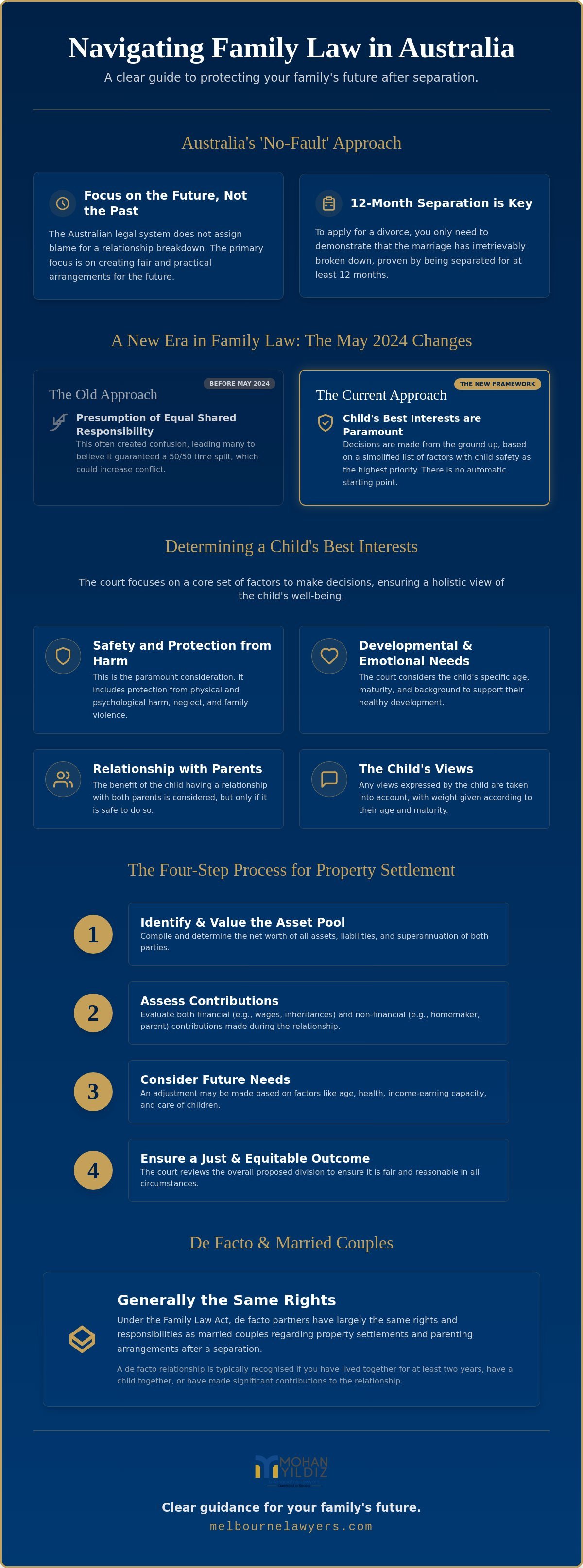
Since the introduction of the Family Law Act in 1975, Australia has operated under a "no-fault" system. This means the court doesn't need to know why a relationship ended; it only needs evidence that the marriage has irretrievably broken down, demonstrated by a 12-month separation. This compassionate approach prevents the legal process from becoming a public airing of private grievances, allowing you to focus on the practicalities of your future instead of the conflicts of your past.
You should distinguish between the administrative side of a separation and the substantive issues. Applying for a divorce is a relatively straightforward legal process to end a marriage, but the real work involves parenting arrangements and property settlements. Throughout all these decisions, the system uses the "best interests of the child" as its North Star. Recent amendments that commenced in May 2024 have further refined this, simplifying the factors the court considers to ensure child safety is always the paramount consideration.
The Role of the Federal Circuit and Family Court
It's a common misconception that every family law matter ends up in a courtroom. In reality, the Federal Circuit and Family Court of Australia is a last resort. The system is designed to encourage you to reach an agreement through mediation or private negotiation first. When cases do reach the court, the focus is heavily on safety. Programs like the "Lighthouse" project are specifically designed to screen for family violence and high-risk factors early in the process, ensuring that vulnerable family members receive the protection they need immediately.
De Facto vs. Married Couples
Many people still believe in the myth of "common law marriage" or worry that they have fewer rights because they weren't legally wed. Under the Act, de facto partners generally have the same rights as married couples regarding property division and parenting. To qualify, you usually need to show you lived together as a couple on a genuine domestic basis for at least two years, have a child together, or that one partner made significant contributions to the relationship. Whether you were married or in a de facto partnership, the law seeks to provide a fair outcome based on the reality of your shared life.
The Family Law Act 1975: Navigating Recent Changes
The Family Law Act 1975 has served as the foundation for domestic legal matters in Australia for decades, but it's far from a static document. In May 2024, the legislation underwent its most significant transformation in years. These amendments weren't merely technical; they represented a profound shift in how the system views the roles of parents and the safety of children. By moving away from rigid legal presumptions, the law now prioritises a flexible, child-centred approach that acknowledges the unique reality of every family.
A major catalyst for this change was the removal of the "presumption of equal shared parental responsibility". For many years, this concept led to widespread confusion, with many parents mistakenly believing that the law guaranteed a 50/50 split of a child's time. This misunderstanding often sparked unnecessary conflict during already stressful separations. The updated family law framework now clarifies that there is no automatic starting point for time or responsibility. Every decision is built from the ground up, based solely on what will best support the child's future.
The New Best Interests Framework
The May 2024 changes replaced a long, complex list of considerations with a simplified framework of six core factors. This streamlined approach makes it much easier for parents to understand what the Federal Circuit and Family Court of Australia considers when making decisions. Judges now focus squarely on the child’s safety, their developmental and emotional needs, and the benefit of having a relationship with both parents, provided it is safe to do so. The child’s own views are also given significant weight, ensuring their voice is heard throughout the process.
Safety and Family Violence
Protection from harm is the paramount consideration under the current law. Australia now recognises a broad definition of family violence that extends beyond physical harm to include emotional, psychological, and economic abuse. Recent legislative updates have also granted courts enhanced powers to share information with police and child protection agencies. If an intervention order is active, it plays a critical role in shaping how parenting orders are drafted. These measures are designed to create a foundation of safety, ensuring that legal outcomes never compromise the well-being of vulnerable family members.
Understanding these legislative shifts can feel daunting, but you don't have to manage it alone. Arranging an initial consultation with Mohan Yildiz & Associates can help you gain a clear, practical understanding of how these new rules apply to your specific circumstances.
Prioritising Children: Parenting Orders and Responsibility
When a family structure changes, your primary concern is likely the emotional well-being and stability of your children. You want to ensure they continue to feel safe, loved, and supported, regardless of where they sleep on a Tuesday night. Navigating family law matters involving children requires a delicate balance between legal requirements and the human need for routine. By focusing on clear, practical arrangements, you can help your children transition into their new reality with as little stress as possible.
Parental responsibility is a key concept in this process. It isn't necessarily about who the child spends more time with; rather, it's about who has the legal authority to make major long-term decisions. This includes choices regarding education, religious upbringing, and significant health issues. While day-to-day decisions are usually made by the parent the child is with at the time, major life choices require a more structured approach to ensure the child's long-term interests are met. For a deeper look at the statutory requirements, the Australian Government's Attorney-General's Department provides extensive resources on how these laws function in practice.
Parenting Plans vs. Consent Orders
You have two main paths for formalising these arrangements. A Parenting Plan is a flexible, informal agreement made in writing and signed by both parents. It's an excellent option for amicable separations where both parties trust each other to remain adaptable as the child's needs change. However, a Parenting Plan is not legally binding. For many, a Consent Order is a more reassuring choice. This is a written agreement that is filed with the court and carries the same legal weight as an order made by a judge after a trial. The benefit is that you can achieve this level of certainty without ever having to attend a court hearing, provided both parties agree on the terms.
Dispute Resolution for Parenting Matters
The law encourages parents to reach their own agreements whenever possible. Before you can apply to a court for parenting orders, you're generally required to attend Family Dispute Resolution (FDR). This is a specialised type of mediation designed to help parents reach a compromise in a safe, neutral environment. If you can't reach an agreement, the practitioner will issue a Section 60I certificate, which is usually required before a court will hear your case. Exceptions to this requirement do exist, particularly in cases involving family violence or extreme urgency where immediate protection is needed.
Financial Settlements and Property Division
Financial stability is often the greatest source of anxiety following a separation. You might worry about losing the family home or how you will support yourself in the years to come. It's a common misconception that assets are automatically split "50/50" in Australia. In reality, family law uses a nuanced approach to ensure the division is fair and equitable based on the unique history and future needs of your specific family unit.
The four-step process for dividing assets, a long-standing practice in Australian courts, has recently been formally codified in the Family Law Act 1975. This legislative update ensures greater transparency and consistency in how settlements are reached. Transparency is reinforced by a statutory duty of full and frank financial disclosure. Both parties must provide a complete and honest picture of their financial position, including all assets, debts, and resources. Failing to meet this requirement can lead to severe penalties and may even result in the court setting aside a final order.
The 4-Step Process Explained
The court follows a logical progression to reach a settlement. You can think of it as a methodical audit of your shared life. The steps include:
- Step 1: Identifying the Pool. This involves listing all assets and liabilities, including the family home, investment properties, bank accounts, and debts. Recent changes to family law also include a specific framework for determining the ownership of pets, moving away from treating them as mere property.
- Step 2: Assessing Contributions. The court evaluates what each person brought to the relationship. This includes financial contributions like wages and inheritances, but also non-financial contributions. Homemaker and parental roles are valued just as highly as financial ones.
- Step 3: Evaluating Future Needs. This step considers your life moving forward. The court looks at earning capacities, age, health, and who will have the primary care of children.
- Step 4: The Just and Equitable Test. Finally, the court steps back to ensure the proposed division is genuinely fair to both parties in the context of the entire relationship.
Superannuation Splitting and Spousal Maintenance
Superannuation is treated as a different type of property that can be split or shared. This is particularly important for partners who may have taken time out of the workforce to care for children. You might also be eligible for spousal maintenance if you're unable to adequately support yourself and your former partner has the capacity to pay. This is distinct from child support; it's designed to provide a financial safety net as you transition to independence. To ensure your assets are protected and your future is secure, you can book a consultation with Mohan Yildiz & Associates to discuss a structured plan for asset division.
Timing is critical. If you were married, you generally have 12 months from the date your divorce order takes effect to commence property proceedings. For de facto couples, the limit is two years from the date of separation. Missing these deadlines can significantly complicate your ability to claim a fair share of the asset pool.
Moving Forward: How a Solicitor Supports Your Journey
The path through separation is rarely a straight line, and it's easy to feel lost in the administrative burden of court forms and filing deadlines. While earlier sections explored the "what" of family law, a solicitor provides the "how." They act as your steady advocate, managing the heavy lifting of procedural requirements and liaison with other parties so you can focus on your family's emotional recovery. This partnership is designed to transform a confusing legal process into a manageable series of steps. By acting as a buffer between you and the legal system, your solicitor ensures that your voice is heard without the emotional exhaustion of direct confrontation.
Reaching an out-of-court settlement is almost always the preferred outcome for families. It saves time, reduces costs, and allows you to maintain control over the final result rather than leaving it to a judge's discretion. However, even an amicable agreement requires precise document preparation to be legally effective. A solicitor ensures that Consent Orders are drafted with the meticulous attention to detail required by the court system, preventing future disputes and providing the legal finality you need to move forward with genuine confidence. This meticulousness is especially vital when dealing with superannuation splitting or complex asset pools.
Choosing the Right Legal Support
Selecting a legal partner is a deeply personal decision. A boutique, person-centred approach often provides a level of dedication that larger corporations can't match. You aren't just another file number; you're an individual with a unique story and a family that deserves protection within the family law system. Clear, practical advice tailored to your life can save significant time and money by avoiding unnecessary legal battles. This commitment to outcome-oriented service ensures that every step taken is a deliberate move toward a fair and stable future for you and your children.
Your First Step: The Initial Consultation
The journey toward resolution begins with a single, focused meeting. This is a safe, confidential space where you can voice your fears and define your objectives without judgment. To get the most out of this time, it's helpful to bring a basic list of your assets, any existing parenting arrangements, and a clear idea of what you hope to achieve. This session isn't just about legal facts; it's about building trust and providing the clarity you need to reduce anxiety. You'll leave with a structured plan and a much clearer understanding of your rights and responsibilities.
Ready to find your way forward? Organise your free initial consultation with our supportive team to gain the expert guidance and peace of mind you deserve.
Securing a Brighter Future for Your Family
Navigating the complexities of family law doesn't have to be a journey you take alone. By understanding the recent legislative shifts and the structured four-step process for property division, you've already taken the first step toward reclaiming your peace of mind. Whether you're prioritising the stability of your children through a Consent Order or seeking a fair financial settlement, clarity is your most valuable asset during this transition. The Australian legal system provides the framework for your safety, but the right guidance ensures that framework works for your unique needs.
At Mohan Yildiz & Associates, we provide dedicated, person-centred legal representation that balances technical expertise with genuine empathy. Our deep understanding of the Family Law Act 1975 allows us to offer clear, practical advice that reduces anxiety and avoids unnecessary conflict. We're committed to achieving the best possible outcome through affordable fees and outcome-oriented advocacy. We manage the heavy lifting of the legal process so you can focus on your family's well-being.
Your future deserves a foundation of safety and certainty. Contact Mohan Yildiz & Associates for a free initial consultation to discuss how we can support your journey toward a fair resolution. You've navigated the hardest part of the separation; now let us help you reach a resolution that protects what matters most.
Frequently Asked Questions
Do I have to go to court for a family law matter?
No, you don't usually have to attend court to resolve a family law dispute. The vast majority of cases in Australia are settled through private negotiation, mediation, or Family Dispute Resolution. If you and your former partner reach an agreement, it can be formalised through Consent Orders, which are filed with the court and approved by a registrar without the need for a hearing.
How long do I have to wait to get a divorce in Australia?
You must be separated for a minimum of 12 months before you can apply for a divorce. This period serves as evidence that the marriage has irretrievably broken down. Since June 2025, the requirement for couples married for less than two years to attend mandatory counselling before filing has been removed, but the 12-month separation rule remains the standard for all applicants.
Is property always split 50/50 after a separation?
There is no automatic 50/50 split of assets under Australian law. Every financial settlement is determined by a codified four-step process that evaluates the unique circumstances of the relationship. This includes identifying the total asset pool, assessing financial and non-financial contributions, and carefully weighing the future needs of both parties, such as their earning capacity and the care of children.
What is the "best interests of the child" principle?
The "best interests of the child" is the paramount consideration that guides every parenting decision made under the family law framework. Since the May 2024 legislative changes, this principle focuses on six core factors, with child safety being the most critical. It ensures that arrangements are designed to support the child's physical and emotional well-being rather than focusing on parental rights.
Can I change my parenting orders if my situation changes?
Yes, you can change your parenting orders if there's a significant change in your circumstances. If both parents agree on the new arrangements, you can simply file a new set of Consent Orders with the court. If you don't agree, you'll generally need to attend mediation before applying to the court to vary the existing orders, provided the proposed change is in the child's best interests.
What happens if my ex-partner refuses to disclose their finances?
If an ex-partner refuses to disclose their finances, they're breaching their statutory duty of full and frank disclosure. This duty is a legal requirement that demands total transparency regarding all assets and debts. The court has significant powers to manage non-compliance, including issuing penalties, making costs orders against the non-disclosing party, or even setting aside a final settlement if hidden assets are discovered later.
Do de facto couples have the same rights as married couples?
De facto couples generally have the same legal rights as married couples regarding property division and parenting arrangements. To access these rights, you must typically show that your relationship lasted at least two years, you have a child together, or that one partner made significant contributions. Proceedings for de facto property settlements must generally be commenced within two years of your final separation.
How much does a family lawyer cost in Australia?
The total cost of family law services varies depending on the complexity of your situation and whether the matter can be resolved out of court. At Mohan Yildiz & Associates, we focus on providing outcome-oriented service with affordable fees and clear, practical advice. We offer an initial free consultation to help you understand your legal position and the potential pathways forward without immediate financial pressure.