

Imagine the weight of losing a loved one, only to discover that their final wishes don't provide for your future as you expected. It's a distressing position to be in, especially when you're already navigating the fog of grief. If you feel you've been unfairly overlooked, contesting a will in Victoria is a legal path designed to ensure that those with a moral claim receive the support they deserve. You aren't alone in this feeling; the law provides specific protections for family members and dependents who find themselves in this difficult situation.
We understand that the thought of a court battle is the last thing you want during a time of mourning. This guide will help you understand your rights, including the strict 6-month deadline from the grant of probate and who is actually eligible to make a claim. With over 30 years of Victorian court experience, we've seen how a calm, methodical approach can lead to a fair distribution through mediation. Because every family dynamic is unique, you should seek legal advice regarding your specific situation.
Key Takeaways
- Learn what contesting a will victoria involves, specifically the process of making a Testator’s Family Maintenance claim for fair provision.
- Identify whether you're an "eligible person" under Victorian law, a category that includes spouses, children, and certain dependents with a moral claim.
- Understand the strict six-month deadline from the date probate is granted to lodge a claim in the Supreme Court of Victoria.
- Discover how mediation serves as a calm, non-adversarial priority for resolving estate disputes before they reach a full court hearing.
- Always seek legal advice regarding your specific situation to ensure your rights are protected with meticulous attention to detail and transparency.
Table of Contents
What Does Contesting a Will in Victoria Actually Involve?
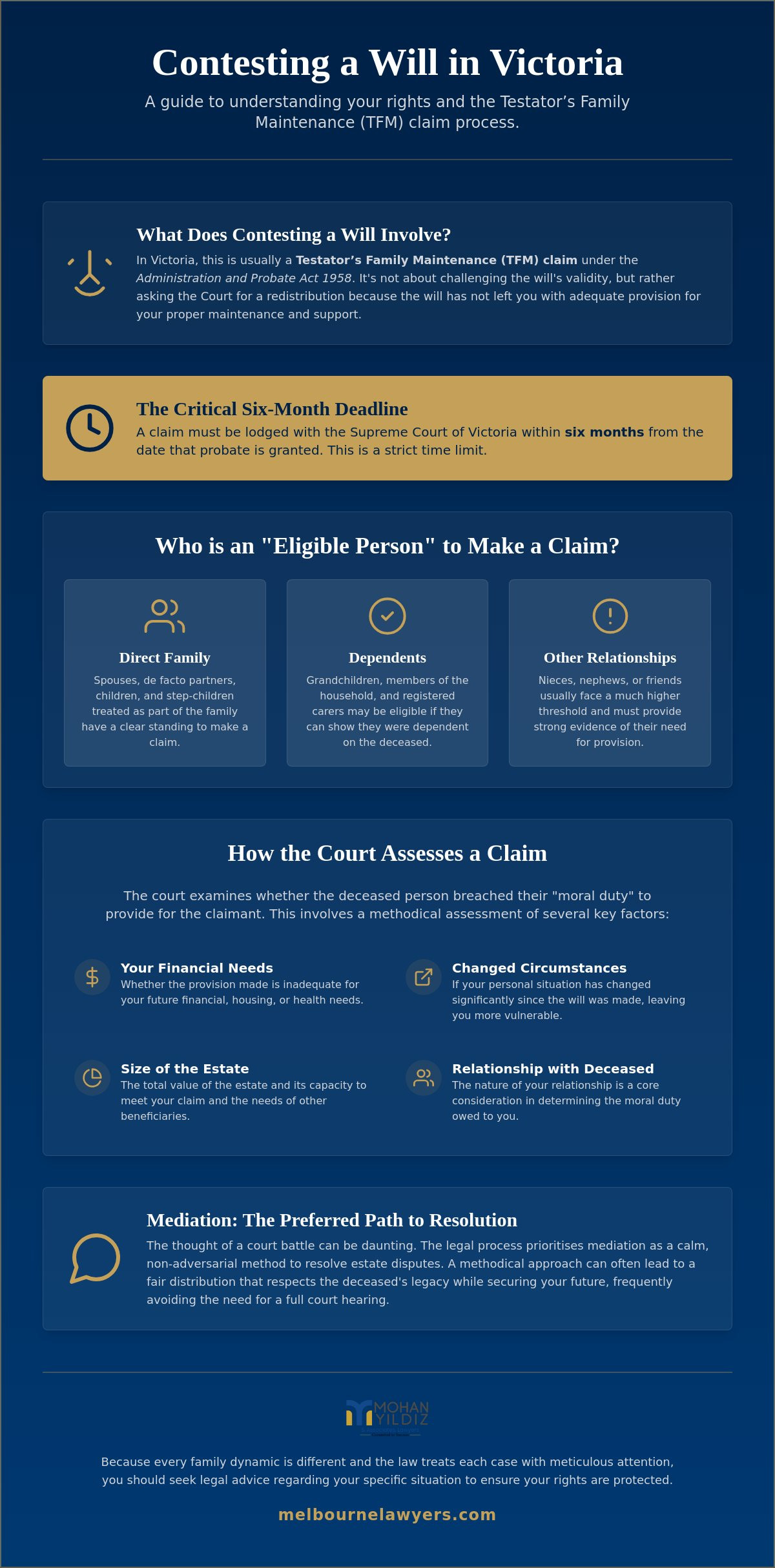
When you begin the process of contesting a will in Victoria, you're usually making what the law calls a Testator’s Family Maintenance (TFM) claim. This is a specific legal application under the Administration and Probate Act 1958. It's essential to understand that this is different from challenging the validity of the will itself. While you might ask what is a will contest? in a general sense, in the Victorian context it specifically refers to asking the court to redistribute the estate because you haven't been left with adequate provision for your proper maintenance and support. For more information on these processes, you can read about our approach to wills and probate.
The Victorian legal system focuses on a sense of balance. It protects the deceased person's right to choose how to leave their assets while ensuring they meet their responsibility to provide for those they leave behind. Our practice, guided by over 30 years of experience in Victorian courts, prioritises a resolution that respects the deceased's legacy while ensuring your future is secure. We focus on transparent communication to help you understand how the law applies to your unique family situation without the need for aggressive conflict.
The Concept of Moral Duty
Victorian courts look closely at whether the deceased person breached their moral duty to the person making the claim. Moral duty is the legal obligation of a will-maker to provide for those they had a responsibility toward. To assess this, the court considers the nature of your relationship and whether the amount you were left is sufficient to meet your daily needs and future security. It's a methodical assessment of what a "wise and just" person would have done in the deceased's position.
Grounds for a Claim in Victoria
There are several practical reasons why a claim might be brought forward under Victorian law. The court will often consider these factors:
-
Whether the provision made for you is inadequate to meet your future financial, housing, or health needs.
-
If your personal circumstances have changed significantly since the will was originally written, leaving you in a more vulnerable position.
-
The total size of the estate and how your claim compares to the competing needs of other beneficiaries named in the document.
Because every family dynamic is different, you should seek legal advice regarding your specific situation to understand the path forward.
Identifying Eligible Persons and the Right to Provision
Not everyone has the legal standing to pursue a claim against a deceased estate. In Victoria, the law defines specific categories of people who are considered "eligible persons." The Supreme Court of Victoria is responsible for determining whether a claim has merit, but it's vital to remember that being eligible is only the first step. Success depends on proving that the deceased person had a responsibility to provide for you and failed to do so. You can find more foundational details in Victoria Legal Aid's guide to challenging a will.
When contesting a will victoria, the court doesn't just look at your relationship; it weighs your current financial position, your future needs, and the size of the estate. It also considers any conduct on your part that might affect the claim. Because these factors are complex and deeply personal, it's often helpful to speak with a professional who can offer a steady, empathetic hand during this process.
Direct Family Members
Spouses and de facto partners who were in a relationship with the deceased at the time of death have a clear right to seek provision. This also extends to children, including adult children and stepchildren who were treated as part of the family. If you're unsure about your standing, reviewing our Wills and probate services can help clarify how these relationships are viewed under the law.
Dependents and Other Relationships
Other individuals may be eligible if they can demonstrate a level of dependence on the deceased. This includes grandchildren or members of the household who relied on the deceased for financial or emotional support. A person in a registered caring relationship with the deceased may also be eligible. In contrast, nieces, nephews, and friends are generally not eligible to make a claim unless they fall within a defined category, such as a household member who was dependent on the deceased.
Every family situation is unique, and the law treats each case with the meticulous attention it deserves. You should seek legal advice regarding your specific situation to understand your rights fully.
Navigating the Legal Timeline and Resolution Methods
When you decide on contesting a will victoria, understanding the clock is ticking is vital. The process involves multiple parties, including the executor, who has a legal duty to defend the estate and act with integrity toward all beneficiaries. Their role is to ensure the deceased's wishes are respected while also facilitating a fair resolution when a claim is made. This methodical approach ensures that every voice is heard without necessarily resorting to a high-conflict courtroom environment.
The Importance of the Six-Month Deadline
Victorian law is very clear about the timeframe for lodging a claim. The six-month limit begins from the date the Supreme Court grants probate. If you miss this window, your ability to seek provision becomes significantly more difficult. While the court has the discretion to hear an "out of time" application, these are only considered in very limited circumstances, such as when the estate hasn't been fully distributed and there's a compelling reason for the delay. You can find more about the formal steps involved via the Supreme Court of Victoria's probate process.
Resolving Disputes Without a Trial
Most estate disputes in Victoria don't end in a trial. Mediation is a structured discussion led by an independent third party, designed to reach a sensible agreement without the emotional and financial strain of a full court hearing. This non-adversarial approach is often mandatory in the Victorian legal system. It allows families to speak openly and find a path forward that preserves relationships. By prioritising dispute resolution, you can achieve a timely and certain outcome that provides the support you need while honouring your loved one's legacy.
Every family dynamic is different, which is why the law treats these matters with such meticulous attention to detail. You should seek legal advice regarding your specific situation to ensure you meet all relevant deadlines and understand your options for mediation.
How Personal Legal Advice Helps Resolve Estate Disputes
When you are considering contesting a will victoria, the emotional weight can feel just as heavy as the legal complexity. We believe that clear, plain-English guidance is the best way to remove the anxiety often associated with these disputes. Our Principal Solicitor brings over 30 years of experience in Victorian courts to every case, providing a steady hand that understands the local legal landscape. This depth of experience allows us to navigate the Supreme Court's requirements with a level of calm and precision that protects your peace of mind.
You deserve transparency from the very first conversation. We are committed to providing a clear breakdown of potential legal costs and fees from the outset, so you don't feel left in the dark about the financial side of your matter. If you are ready to discuss your circumstances, please contact our Melbourne legal team for a confidential discussion.
A Meticulous and Empathetic Approach
Family matters are deeply personal and require a sensitive touch. We provide individual attention to every client, ensuring that your unique story is at the centre of our work. By focusing on a meticulous preparation of documents and evidence, we make sure your voice is heard clearly by the court or during mediation. Our goal is to resolve the dispute through steady advocacy that avoids escalating family conflict, prioritising a respectful outcome for everyone involved.
Taking the First Step Toward Clarity
Gathering information early is one of the most effective ways to protect your rights and ensure you meet the strict Victorian deadlines. A solicitor provides a realistic assessment of your situation, helping you understand the likely path forward without making false promises. This clarity allows you to make informed decisions about your future and the legacy of your loved one. Because every situation is unique, you should seek legal advice regarding your specific circumstances to ensure your rights are fully protected.
Securing Your Future with Clarity and Support
Navigating the legal landscape after the loss of a loved one is a significant challenge, but you don't have to manage it alone. By understanding the eligibility criteria and the strict six-month deadline for contesting a will victoria, you've already taken the first step toward protecting your rights. The Victorian legal system prioritises fair provision and sensible mediation, allowing for resolutions that respect family relationships while ensuring your future security is addressed with the care it deserves.
At Mohan Yildiz & Associates, we bring a methodical and empathetic approach to every estate dispute. Our Principal Solicitor offers over 30 years of Victorian court experience, ensuring your matter is handled with meticulous attention to detail and quiet confidence. We provide plain-English advice and maintain a firm commitment to transparent fees, so you always know where you stand. Our focus remains on achieving a calm, non-adversarial resolution that provides the relief you need during a difficult time.
Every family situation is unique, and the law applies differently to every set of circumstances. You should seek legal advice regarding your specific situation to ensure your interests are fully protected and your voice is heard.
Frequently Asked Questions
How long do I have to contest a will in Victoria?
You have exactly six months from the date the Supreme Court of Victoria grants probate or letters of administration to lodge a claim. This is a strict deadline set by the Administration and Probate Act 1958. While extensions are possible in very rare cases, they're only considered if the estate hasn't been fully distributed. It's essential to seek legal advice regarding your specific situation as soon as possible to ensure you don't miss this window.
Can a stepchild contest a will in Victoria?
Yes, stepchildren are considered eligible persons under Victorian law. If you were a stepchild of the deceased at the time of their death, or if you were treated as a child of the family, you have the right to seek provision. The court assesses the nature of your relationship and your financial needs during the process. This ensures that members of blended families are protected and treated with the fairness they deserve.
What is a Testator’s Family Maintenance (TFM) claim?
A Testator’s Family Maintenance (TFM) claim is the formal legal name for contesting a will victoria. It's an application made to the court by an eligible person who believes they haven't been left with adequate provision for their proper maintenance and support. Unlike a challenge to a will’s validity, a TFM claim focuses on whether the distribution is fair given the deceased person’s moral duty to their family and dependents.
Do I have to go to court to contest a will?
You don't necessarily have to appear in a courtroom to resolve an estate dispute. In fact, the Victorian legal system requires mediation as a priority before any trial takes place. Mediation is a calm, structured discussion where all parties work with an independent mediator to reach a settlement. Most claims are resolved during this stage, which helps preserve family relationships and avoids the stress of a formal trial. It's a more private and steady path to resolution.
What factors does the court consider when deciding a claim?
The Supreme Court of Victoria examines several key factors to determine the merits of a claim. These include your current financial position, your future needs, and the nature of your relationship with the deceased. The court also weighs the size of the estate against the competing needs of other beneficiaries. This methodical assessment ensures that any redistribution is fair and reflects the moral duty the deceased had toward their dependents. You should seek legal advice regarding your specific situation.
Disclaimer
This article is general information only and is not legal advice. Laws change, and every situation is different. Contact Mohan Yildiz & Associates for advice about your circumstances.


