

What if the business you’ve spent decades building is suddenly treated as just another line item on a balance sheet? For many Melbourne business owners, the fear that a separation will dismantle their life's work is a heavy burden. You've likely invested more than just capital; you've poured in your time, identity, and future security. It's natural to feel anxious about how your employees will be affected or whether you'll be forced to sell. It is common to worry about what happens to a business in a divorce Australia-wide, especially when your livelihood depends on its continued operation.
We understand that you need a strategy that respects your professional legacy. This article explains how Australian family law treats commercial assets and the practical steps you can take to protect your livelihood. We explain how the Court identifies each party's legal and equitable interests, how commercial assets are valued, and how the changes that commenced on 10 June 2025 apply to property settlements. Our goal is to provide the clarity you need to reach a fair, non-adversarial resolution that allows your business to thrive.
Key Takeaways
- Learn how Australian family law classifies business interests as property within the matrimonial asset pool, whether you operate as a sole trader, partnership, or company.
- Understand the "fair market value" approach to valuation, which considers not just your balance sheet but also intangible assets like goodwill and future earning capacity.
- Discover practical strategies to maintain your business's daily operations and protect your employees while navigating what happens to a business in a divorce in Australia.
- Understand how family law and commercial considerations are dealt with together in working towards a just and equitable settlement without a forced sale.
Understanding Businesses as Property in Australian Family Law
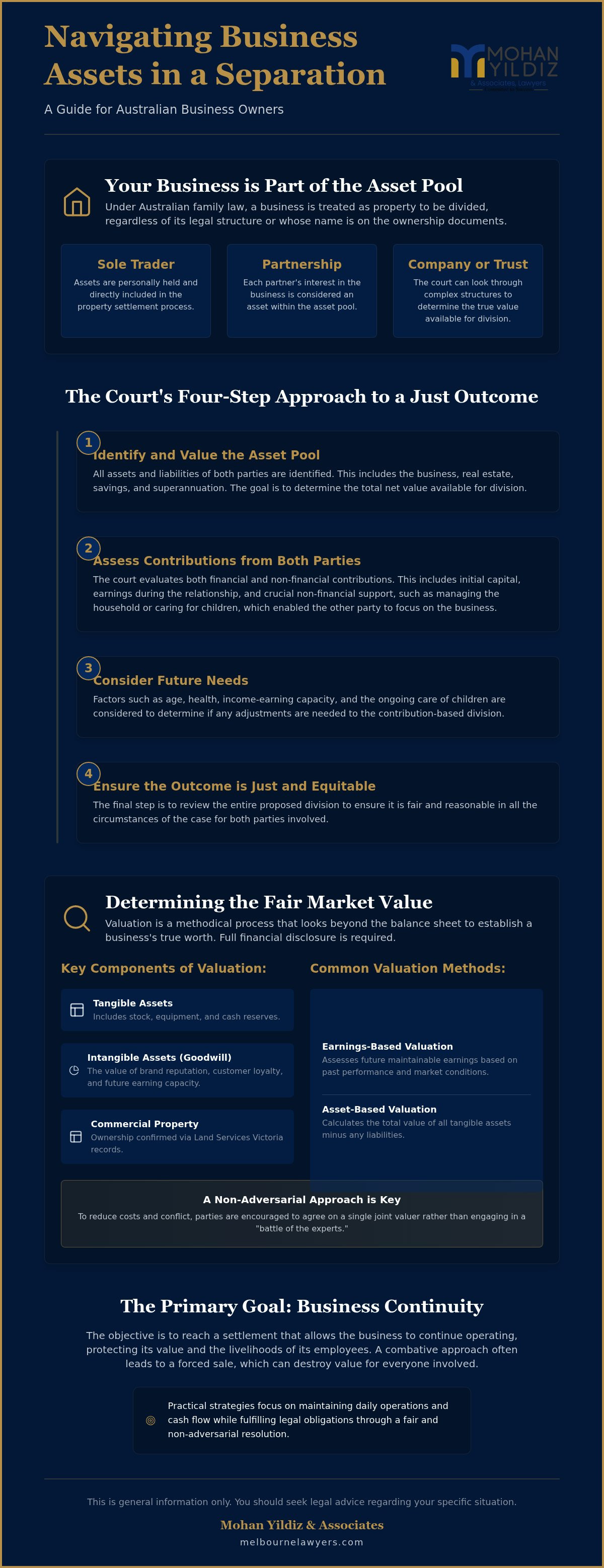
Under the Family Law Act 1975, property means property to which the parties, or either of them, are entitled, whether in possession or reversion. A business interest falls within that definition. In Australian family law, your business is not viewed as an untouchable entity separate from your marriage. Instead, it's generally classified as property and included in the total asset pool for division. This reality often leads to questions about what happens to a business in a divorce in Australia-wide, as the court seeks a just and equitable outcome for both parties. This applies regardless of whether the business is a sole proprietorship, a partnership, or a proprietary limited company.
Does it matter whose name the business is in?
Legal ownership on a share register doesn't shield an asset from settlement. The Federal Circuit and Family Court of Australia looks beyond the name on the title. They evaluate both financial inputs and non-financial contributions made during the relationship. If one partner managed the household or raised children while the other built the brand, the Court takes that into account under section 79(4)(c) as a contribution to the welfare of the family, weighed alongside financial and non-financial contributions, rather than as a direct contribution to the business’s success. Your partner’s role at home is often seen as the foundation that allowed you to focus on commercial growth.
Sole Traders vs. Companies and Trusts
The structure of your enterprise changes how it's reviewed, but not whether it's included. Sole trader assets are personally held and easily identified during property settlement. Conversely, companies and family trusts involve layers of governance that require a deep understanding of commercial and business law to untangle. While these structures are more complex, the Court examines each party's legal and equitable interests in the entity, the degree of control held, and the nature of any financial resources. Understanding what happens to a business in a divorce in Australia involves recognising that every structure, from a local partnership to a proprietary limited company, is subject to scrutiny.
Valuing a Business During Property Settlement
Determining the fair market value of your enterprise is a critical step that requires a calm, methodical approach. It's often the most complex part of understanding what happens to a business in a divorce Australia-wide. Valuation isn't just about the current balance sheet; it must account for stock, equipment, and future earning capacity. Goodwill represents the value attributable to the capacity of a business to generate earnings beyond the value of its identifiable net assets. To ensure your brand identity is legally secured as part of this value, you might explore Trademark Registration and Search Fees through an established intellectual property firm like Henry Goh & Co. To keep the process non-adversarial and reduce costs, parties are encouraged to agree on a single joint valuer rather than engaging in a "battle of the experts."
Common Valuation Methods Used in Australia
Valuers commonly use one of two approaches, although other methods may suit a particular business. Earnings-based valuation assesses future maintainable earnings by looking at past performance and market trends. Alternatively, an asset-based valuation sums the value of all tangible assets and subtracts liabilities. Both methods depend on complete financial information. Since 10 June 2025, full and frank disclosure has been a duty written into the Family Law Act at section 71B, and it applies to separated parties preparing for proceedings, not only after a case is filed. If you feel overwhelmed by these figures, you might find it helpful to speak with a professional who understands the nuances of commercial entities.
The Role of Land Services Victoria in Business Property
If your business owns commercial real estate, the valuation process extends to property titles. Land Services Victoria records are used to verify ownership and any encumbrances that might affect the entity's value. These titles are integral to property settlement and financial disputes because they often represent a significant portion of the business's total worth. A clear title verification ensures that the final valuation reflects the true state of your commercial interests, providing a solid foundation for a just outcome. Understanding what happens to a business in a divorce in Australia requires this level of meticulous detail to protect your long-term stability.
Practical Strategies for Managing Business Interests After Separation
Protecting your livelihood requires a focus on continuity. Most business owners aim to keep the doors open while fulfilling their legal obligations. Adopting a combative stance often leads to a forced sale, which destroys value for everyone involved. To help you manage your business's cash flow during this time, we agree our fees with you in advance. This allows you to plan your commercial budget with certainty. It's also vital to handle parenting arrangements separately. Mixing parenting disputes with commercial negotiations often clouds judgement and complicates the path to a fair result when determining what happens to a business in a divorce Australia-wide.
Options for Settlement
There are several ways to reach a resolution that doesn't involve closing your doors. Many couples choose one of the following paths:
- One party buys out the other: This often involves using other assets, such as the family home or superannuation, to compensate the non-owning spouse.
- Offsetting the business value: You can balance the business’s worth against other property in the asset pool to ensure a fair distribution of total wealth.
- Selling the business: While this is usually a last resort, it may be necessary if neither party can afford a buyout or if the business cannot function post-separation.
Where practicable, parties often seek to sell as a going concern rather than through a rushed liquidation, so the price better reflects market value.
Using a Binding Financial Agreement
A Binding Financial Agreement can be a powerful tool post-separation. It allows you to formalise exactly how the business will be handled without requiring a court order. It does not bind employees, suppliers or creditors, but it removes the uncertainty of a contested court outcome, and it must meet the requirements of section 90G to be effective. For more context on the emotional and legal journey, you might read our compassionate guide to navigating family law in Australia. Taking this step ensures that what happens to a business in a divorce in Australia is decided by you, not the court.
How Professional Guidance Simplifies Business Asset Division
Resolving the overlap between Australian family law and commercial interests requires a steady, experienced hand. At Mohan Yildiz & Associates, our principal solicitor handles your matter directly. This ensures that over 30 years of Victorian legal experience is applied to every facet of your case. We provide plain-English advice to help you understand your rights and obligations without the confusion of dense legalese. Our approach focuses on achieving a resolution that protects both your commercial future and your personal well-being. We understand that your business is more than just an asset; it is your livelihood and your legacy.
Direct Principal Support in Broadmeadows and Chadstone
Whether you are operating out of Pascoe Vale, Glenroy, or Moonee Ponds, we offer accessible consultations at our Broadmeadows and Chadstone offices. For clients who prefer to discuss complex financial matters in their native tongue, we provide Turkish-language services (Türkçe hizmet). Every business structure and family dynamic is unique. It is essential to seek legal advice tailored to your specific circumstances rather than relying on generalisations about what happens to a business in a divorce in Australia. We take the time to understand the nuances of your industry and the specific contributions you have made to your enterprise.
Starting the Process with Clarity
Clear communication is the foundation of a successful solicitor-client relationship. We agree our fees with you in advance and confirm them in writing, allowing you to manage your business's cash flow with certainty. If your dispute involves contractual issues alongside your separation, we also act in commercial litigation. Taking the first step towards clarity doesn't have to be intimidating. You can contact Mohan Yildiz & Associates today to discuss how we can help you move forward with confidence while addressing the complexities of what happens to a business in a divorce in Australia.
Securing Your Business Legacy and Your Future
Separation brings significant change, but it doesn't have to mean the end of the business you've worked so hard to build. By understanding how the law treats a business on separation, you can approach negotiations with a focus on continuity rather than conflict. Whether you're exploring a buyout or offsetting assets, the goal is always a just and equitable outcome that respects your commercial and domestic contributions.
Principal Mohan Yildiz brings over 30 years of Victorian legal experience to your side. We provide plain-English advice tailored to your specific commercial situation, ensuring you feel supported at every step. You deserve a dedicated advocate who values your tenacity and prioritises your personal well-being.
With the right guidance and a methodical approach, you can protect your livelihood and step into your next chapter with quiet confidence.
Frequently Asked Questions
Can I protect my business from a divorce in Australia?
You can protect your commercial interests by entering into a Binding Financial Agreement either before or during your relationship. Without a valid agreement, the court generally treats the business as property within the matrimonial pool. While the asset is included, strategic negotiations can help you retain ownership by offsetting other assets like the family home or superannuation.
How is a small business valued in an Australian divorce?
Small businesses are typically valued at "fair market value" by an independent forensic accountant acting as a single expert witness. This valuation considers tangible assets like equipment and stock, alongside intangible goodwill and future maintainable earnings. The valuer reviews several years of tax returns and financial statements to reach a figure. Agreeing on a joint valuer early helps maintain a non-adversarial process and significantly reduces your overall legal costs.
What happens if my spouse and I own the business together?
If you co-own a business, the most common resolution is for one party to buy out the other’s shares or interest. In some cases, the business is sold, and the net proceeds are divided according to the property settlement agreement. While some couples attempt to continue as co-directors, this is often difficult post-separation. We focus on finding a structural solution that allows for a clean break while ensuring the business remains operational.
Do I have to sell my business to pay spousal maintenance?
Selling a business to pay spousal maintenance is uncommon. Maintenance is usually met from ongoing income or business profits rather than the capital value of the entity, though there is no rule to that effect and the outcome depends on the circumstances. However, the business’s value is a major factor in the overall property settlement. Understanding what happens to a business in a divorce in Australia involves balancing your future income needs against the other party’s right to a fair share.
Will my inheritance or pre-marriage business be included in the property settlement?
Yes, businesses owned before the marriage or acquired through inheritance are included in the total asset pool. However, the court recognises these as significant initial contributions made by you. The weight given to these contributions often depends on the length of the relationship and how much the business grew during that time. Meticulous records of the business's value at the start of the relationship are essential for protecting your initial investment.
Principal Solicitor of Mohan Yildiz & Associates, with over 30 years' experience in Victorian courts across family law, criminal defence, wills and estates, and property matters. Offices in Broadmeadows and Chadstone, with consultations available across Melbourne.
Disclaimer
This article is general information only and is not legal advice. Laws change, and every situation is different. Contact Mohan Yildiz & Associates for advice about your circumstances.


