

What if the most expensive mistake you make during your property settlement isn't the price on the contract, but the hidden costs you never saw coming? It's a common concern for many Australians, especially when the excitement of a new purchase is overshadowed by the complexity of legal paperwork. You likely believe that a property transaction should be transparent; yet, the distinction between professional conveyancing fees and government disbursements often feels intentionally blurred.
We understand that you want more than just a transaction. You want the certainty that your legal interests are protected without facing "nasty surprises" on settlement day. This guide provides total clarity on the professional costs and administrative disbursements involved in Australian settlements for 2026. We will break down the latest PEXA fee adjustments and state-specific search costs, offering you a steady, expert path toward a fixed-fee quote and a smooth, stress-free settlement process.
Key Takeaways
- Learn to distinguish between professional service fees and disbursements, which are the essential third-party costs your solicitor manages to finalise your settlement.
- Understand why a solicitor-led firm offers broader protection, providing the expertise needed to navigate complex disputes that a standard conveyancer might not be equipped to handle.
- Gain total clarity on conveyancing fees for 2026, including the most recent PEXA platform adjustments and state-based title search costs.
- Don't let hidden costs catch you off guard; identify administrative outgoings like Verification of Identity (VOI) fees and local council certificates well before settlement day.
- Follow a methodical settlement journey that prioritises your peace of mind, moving from contract review to final keys with a focus on integrity and transparency.
Understanding Conveyancing Fees: What Are You Paying For?
Conveyancing is the legal process of transferring property ownership from one person or entity to another. While it might seem like a straightforward exchange of keys for cash, it is actually a high-stakes legal transaction involving the transfer of significant wealth and debt. Most Australians are surprised to find that conveyancing fees aren't a single, flat sum. Instead, they are typically split into two distinct categories: professional legal fees and administrative outgoings, commonly known as disbursements. This distinction is vital for your budget and your peace of mind.
You might feel tempted to manage the paperwork yourself to save money. However, the "DIY" approach carries substantial risks that can lead to delayed settlements or even the loss of your deposit. Professional legal representation acts as a foundation of safety. By engaging an expert, you ensure that every document is filed correctly and every legal obligation is met. In the modern Australian market, the "fixed-fee" model has become the gold standard. It provides a level of certainty that helps you plan your move without the fear of an escalating bill.
The Role of Professional Legal Fees
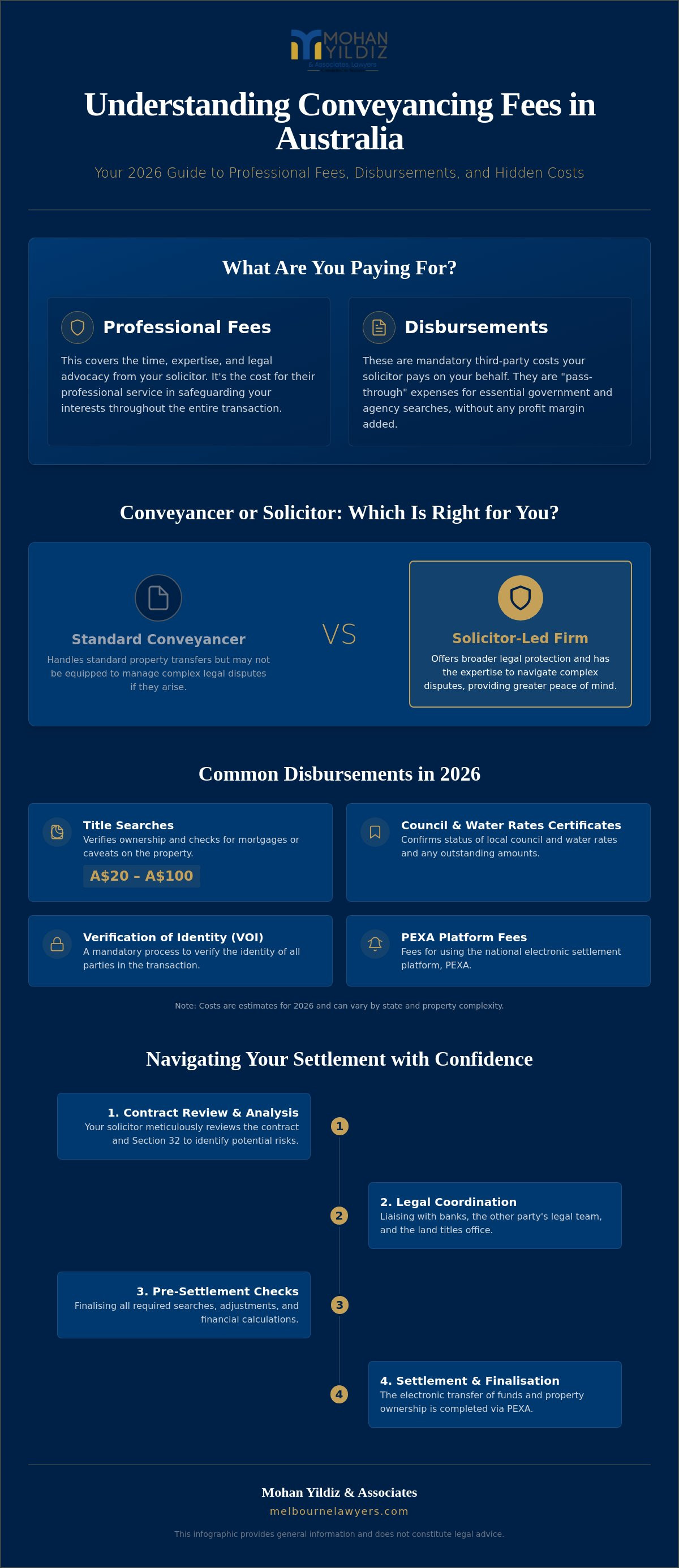
Professional fees cover the time, expertise, and advocacy provided by your legal team. This work begins long before settlement day. For a foundational look at the legalities, Understanding Conveyancing helps clarify the scope of work involved. Your solicitor performs a meticulous review of the contract of sale and a thorough Section 32 analysis to identify any potential red flags. They also handle the complex coordination required between banks, the other party's legal team, and the land titles office.
The complexity of your specific property can influence the professional time required. If the title includes restrictive covenants, heritage overlays, or unexpected caveats, your solicitor must dedicate more time to ensuring these don't jeopardise your interests. This attention to detail is what prevents future litigation. It's a proactive investment in your financial security.
Why Fee Transparency Matters in 2026
In 2026, the property landscape is defined by tighter lending standards and significant regulatory shifts. You are likely seeking a partner who offers more than just technical competence; you want a steady, expert guide through a potentially stressful time. A clear, transparent quote reduces settlement-day anxiety by removing the "nasty surprises" that often plague property deals.
It's important to distinguish between "cheap" quotes and genuine value. Some high-volume operators offer a low base rate but then add surcharges for every email, phone call, or contract extension. This can leave you feeling frustrated and unprotected. A true fixed-fee structure prioritises your well-being. It ensures that your solicitor is motivated by the success of your settlement rather than the number of hours they can bill to your file. This methodical approach reflects a commitment to fairness and integrity in every transaction.
Professional Fees vs. Disbursements: The Cost Breakdown
To understand the total investment required for your property transaction, you must look beyond the initial headline figure. Total conveyancing fees are comprised of two distinct elements: the professional fee for legal expertise and disbursements for external administrative requirements. While the professional fee reflects the value of your solicitor's time and advocacy, disbursements are third-party costs incurred by your solicitor on your behalf to complete necessary property searches and registrations.
These outgoings are essentially "pass-through" costs. Your legal team pays these fees to government bodies or service providers and then includes them in your final statement, typically without adding a profit margin. Because these searches are required by law or requested by your lender to secure their interest, they are mandatory regardless of which firm you choose. When you compare quotes, always check if the disbursements are estimated clearly. A firm that obscures these costs may not be providing the transparency you need for a stress-free settlement.
Common Disbursements in Australian Settlements
The specific searches required can vary based on regulations set by different government bodies or the relevant land titles office requirements across Australia. Generally, your settlement statement will include several key items:
- Title searches: These verify the vendor actually owns the land and identify any existing mortgages or caveats. In 2026, these typically cost between A$20 and A$100.
- Council and water rates certificates: These ensure no outstanding debts are transferred to you. A local council building certificate can cost approximately A$250.
- Land tax and planning reports: These documents check for future encumbrances or zoning issues that might affect your property's value or your intended use.
PEXA and Digital Settlement Platform Costs
The vast majority of property transactions in Australia now occur via PEXA, the national electronic settlement network. This digital platform has almost entirely replaced the old system of physical paper exchanges at a bank. It is a significantly safer and faster method; it provides real-time confirmation of the lodgement of dealings and the immediate disbursement of funds. Digital settlement reduces the risk of manual errors and ensures that the transfer of ownership happens the moment funds are cleared.
As of July 2026, the standard PEXA fee is approximately A$130. This fee is adjusted annually based on the Consumer Price Index and remains standard across the industry. By using this platform, you gain the security of encrypted transactions and the peace of mind that your title is registered without delay. If you're feeling uncertain about the specific outgoings for your purchase, you can speak with a property lawyer at Mohan Yildiz & Associates to receive a detailed breakdown tailored to your contract.
Conveyancer or Solicitor: Which is Right for You?
Choosing between a licensed conveyancer and a solicitor is one of the first decisions you'll make when preparing for a property transaction. While both are qualified to handle the transfer of title, their scope of practice differs significantly. Licensed conveyancers, often represented by the Australian Institute of Conveyancers, are specialised technicians who focus exclusively on property law. Solicitors, however, are broader legal experts with the authority to provide advice on the wider implications of your purchase, such as how it affects your estate planning or tax obligations.
You might wonder if the slightly different conveyancing fees associated with a law firm are necessary for what seems like a "simple" residential sale. It's helpful to view this choice as a foundation of safety for your investment. If a dispute arises or the other party breaches the contract, a solicitor can immediately step in to protect your interests through litigation or formal dispute resolution. A standard conveyancer would typically need to refer you to a law firm at that point, which can lead to frustrating delays and additional costs during a critical settlement window.
When a Solicitor is Essential
Certain transactions demand a higher level of legal scrutiny that goes beyond standard paperwork. If you are purchasing property through a family trust or a self-managed super fund (SMSF), the compliance requirements are significantly more complex. Similarly, high-value commercial property transactions or titles involving heritage overlays, contaminated land issues, or nuanced easements require a lawyer's ability to interpret complex legal risks. In these scenarios, the professional oversight of a solicitor ensures that your interests are protected against unforeseen liabilities that a technician might not be trained to spot.
The Value of Meticulous Legal Oversight
Our firm acts as a steady, expert guide, ensuring that every detail of your transaction is handled with tenacity. A solicitor-led approach is specifically designed to catch subtle errors in a Section 32 statement or a Contract of Sale that could lead to future litigation. This meticulousness provides long-term protection for your most significant financial asset. It isn't just about reaching the settlement date; it's about ensuring your ownership is secure and your investment is sound for the years ahead. By prioritising transparency in our conveyancing fees, we ensure you feel supported and certain that your legal interests are the primary focus of our work.
Hidden Costs and Regulatory Requirements to Watch
While a fixed-fee quote provides a foundation of certainty, you should remain aware of specific regulatory outgoings that often surprise unprepared buyers. These are not arbitrary additions to your conveyancing fees; rather, they are mandatory safety measures and state-based requirements designed to protect the integrity of your purchase. Understanding these "nasty surprises" early allows you to budget with total clarity and avoid eleventh-hour stress.
One significant factor often overlooked is the cost of settlement delays. If you are unable to settle on the scheduled date, you may be liable for penalty interest. In a standard Australian property contract, this interest rate is often set between 10% and 12% per annum, calculated daily on the outstanding balance. This is why meticulous coordination is essential. Similarly, you must distinguish between your legal costs and stamp duty. Stamp duty is a significant government tax that, for a non-first-home buyer in 2026, can cost approximately A$21,970 on a A$500,000 property in Victoria or A$17,029 in New South Wales. These figures are calculated entirely separately from your solicitor's professional fees.
Verification of Identity (VOI) and Anti-Fraud Measures
Verification of Identity is a mandatory requirement across Australia to combat title fraud and identity theft. It ensures that the person selling the property is the rightful owner and that you, as the buyer, are who you claim to be. You can typically complete this process in-person at an Australia Post outlet for a small fee, usually under A$25, or via secure digital applications. These measures are a vital safety net. They provide the reassurance that your most significant financial transaction is protected from sophisticated criminal activity.
State-Specific Search Variations
The definition of a "standard" search changes as you cross state borders. For example, if you are purchasing an apartment or a townhouse in Melbourne or Sydney, you will require an Owners Corporation or Body Corporate certificate. These documents, which detail the financial health and insurance of the building, can add between A$150 and A$250 to your disbursements. These costs are set by the strata managers and are necessary to ensure you aren't inheriting the previous owner's unpaid levies or special assessments.
You should also consider the value of optional but highly recommended searches. While a building and pest inspection is an additional upfront cost, it is a small price to pay to avoid purchasing a property with structural defects. If you want to ensure your budget is fully protected, get a detailed conveyancing quote that accounts for these specific state requirements. By addressing these details now, you ensure a smooth, methodical path to settlement without the fear of hidden charges.
Navigating Your Settlement with Confidence
Moving from the initial contract review through to the final exchange of keys is a journey that requires both technical precision and genuine personal support. As we have explored, gaining total clarity on the breakdown of conveyancing fees is the first step toward reclaiming control over your property transaction. By choosing a partner who values transparency and integrity, you ensure that the focus remains exactly where it belongs: on securing your new home or investment without the shadow of financial uncertainty. A successful settlement is built on a foundation of trust, where every administrative outgoing and professional service is clearly explained from the outset.
Many traditional legal practices still rely on hourly billing, which can lead to significant anxiety as a settlement becomes more complex. We believe in a different, more empathetic approach. A fixed-fee model removes the stress of the "ticking clock," allowing you to ask questions and seek detailed advice without fearing an additional charge for every phone call or email. This commitment to "no surprises" billing is not just about the final statement; it's about fostering a relationship where you feel protected rather than intimidated by the legal process. It allows your solicitor to act as a steady, expert guide through every step of the journey.
The Mohan Yildiz & Associates Difference
At Mohan Yildiz & Associates, we pride ourselves on being a boutique, person-centered practice where you are treated as an individual, not just a file number in a high-volume system. We understand that property transactions are often tied to significant life changes, and we offer a human-centric legal experience that prioritises your peace of mind. We provide an initial free consultation to discuss your specific needs, ensuring we understand the nuances of your transaction before any work begins. Our tenacity in advocacy means we go to great lengths to protect your interests, providing the meticulous attention to detail required to catch errors in a Section 32 or contract that others might overlook.
Next Steps for a Stress-Free Property Transfer
To ensure a smooth and methodical transfer of ownership, we recommend taking a few proactive steps early in the process. Preparation is the best defence against settlement-day surprises. Use the following checklist to keep your transaction on track:
- Request a transparent quote: Ensure your quote includes a clear distinction between professional fees and estimated disbursements like PEXA and title searches.
- Prioritise the contract review: Organise your legal review before you sign to identify any restrictive covenants or heritage overlays that may affect your plans.
- Complete your VOI promptly: Finalise your Verification of Identity early to avoid administrative bottlenecks as you approach the settlement date.
Organising your paperwork early helps you avoid unnecessary rush fees and ensures that your solicitor has ample time to perform the thorough checks required for a safe settlement. This disciplined approach ensures that your most significant financial asset is protected by a team that is deeply invested in your personal success. If you are ready to move forward with certainty, you can secure your property settlement with a fixed-fee quote from Mohan Yildiz & Associates.
Secure Your Property Settlement with Certainty
You deserve a settlement process defined by transparency rather than confusion. By understanding the vital distinction between professional expertise and third-party disbursements, you can budget for your conveyancing fees with total confidence. Choosing a solicitor-led firm provides a foundation of safety; it ensures that even the most complex title issues or contract disputes are handled with meticulous care and tenacity.
At Mohan Yildiz & Associates, we don't treat you as a file number. We act as your dedicated advocate and steady guide, providing direct access to experienced solicitors and personalised, empathetic legal support. Our fixed-fee conveyancing structure is designed with your peace of mind in mind, ensuring there are no hidden surprises or escalating costs as you approach your settlement date. We are committed to protecting your interests with the integrity and detail your investment deserves.
If you are ready to move forward with a partner who prioritises your clarity and protection, Book a Free Consultation with our Property Law Experts today. We look forward to helping you achieve a smooth, stress-free transition into your next property.
Frequently Asked Questions
How much are average conveyancing fees in Australia for 2026?
Typical professional fees for residential property transactions in 2026 vary significantly depending on your state and the complexity of the contract. In Victoria, professional fees for a standard purchase often range between A$840 and A$1,500, while metro areas in New South Wales can see costs from A$1,000 to A$3,000. These figures represent the market standard for the legal expertise required to manage a safe transfer of ownership.
What is the difference between a conveyancing fee and a disbursement?
A professional conveyancing fee is the charge for your solicitor’s time, legal advice, and meticulous management of your file. Conversely, a disbursement is a third-party cost your solicitor pays on your behalf, such as government title searches or local council certificates. We provide a clear breakdown of these outgoings to ensure you have total transparency and face no "nasty surprises" at settlement.
Are conveyancing fees tax-deductible for investment properties?
Most conveyancing fees for an investment property are not immediately deductible as a standard rental expense on your annual tax return. Instead, the Australian Taxation Office generally requires these costs to be added to the property's cost base. This is beneficial in the long term, as it reduces your capital gains tax liability when you eventually decide to sell the asset.
Do I have to pay conveyancing fees if the property sale falls through?
If a property transaction is terminated before it reaches settlement, you are usually responsible for the professional fees related to the work already performed. This covers the time spent on contract reviews, initial searches, and negotiations with the other party’s legal team. We recommend discussing these potential costs during your free initial consultation so you feel protected regardless of the outcome.
Why do solicitors charge more than online conveyancing platforms?
Solicitors offer a higher level of risk mitigation and legal advocacy that high-volume online platforms often cannot match. While a digital platform might process your paperwork, a solicitor-led firm can provide expert advice on complex title disputes, tax implications, or related estate planning. You are investing in a steady, expert guide who has the authority to represent your interests if the matter moves to litigation.
What is the PEXA fee, and is it mandatory for all settlements?
The PEXA fee is the cost of using the national electronic settlement platform, which is now mandatory for nearly all property transactions in Australia. As of July 2026, the standard PEXA fee is approximately A$130. This digital system is far more secure than old paper-based methods, allowing for the real-time transfer of funds and the immediate registration of your title at the land registry.
How much should I budget for disbursements on a standard residential purchase?
You should generally budget between A$200 and A$500 for disbursements during a standard residential purchase. This budget covers mandatory outgoings like title searches, which typically cost between A$20 and A$100, and local council certificates. If you are buying an apartment, you may need to allow extra funds for owners corporation certificates, which often cost between A$150 and A$250 depending on the strata manager.
Can I perform my own conveyancing to save on professional fees?
While you can legally perform your own conveyancing, it is a high-stakes task that carries significant financial risk. Without professional indemnity insurance or a deep understanding of property law, a simple administrative error could lead to a breached contract or a lost deposit. Most banks also require a qualified professional to manage the PEXA settlement process to ensure their mortgage interest is correctly registered.