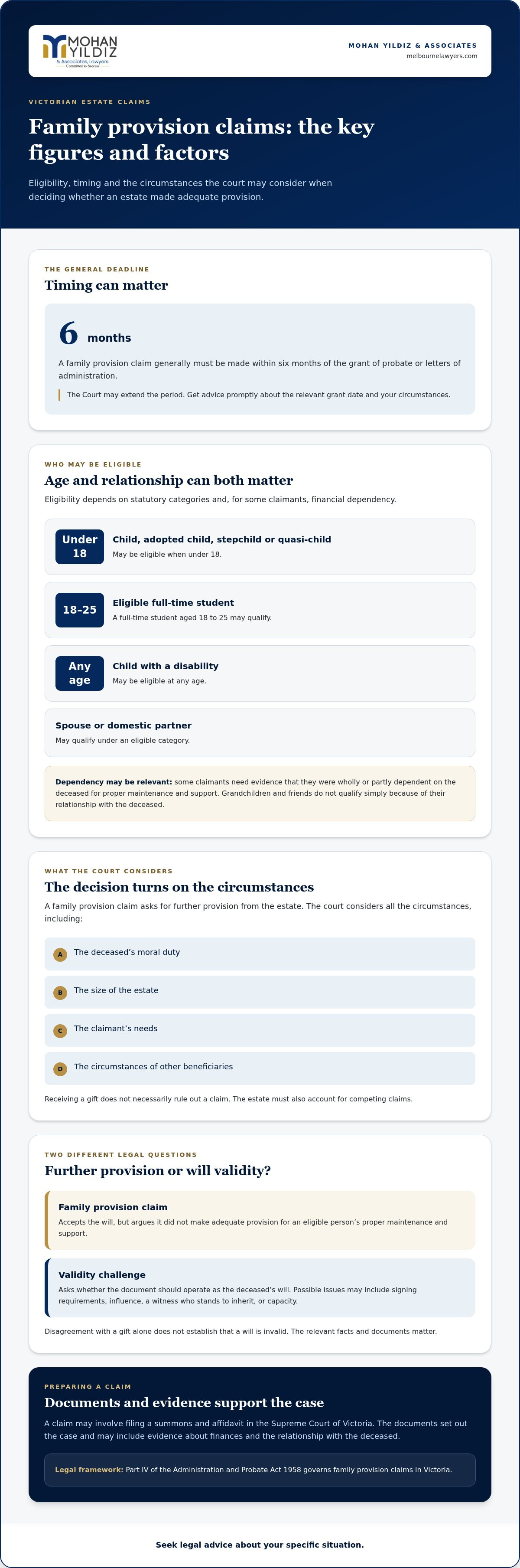
In Victoria, an eligible person who believes a deceased person’s estate has not adequately provided for them may bring a family provision claim, generally within six months of probate or letters of administration. Understanding how to contest a will in Victoria starts with identifying whether you’re eligible and which type of claim may fit your circumstances.
Questioning a will can be difficult while you’re grieving and dealing with its effects on your family. A claim isn’t simply about disagreeing with the will: the court considers eligibility, the provision made and the claimant’s circumstances.
This article explains who may claim, how the process works and what can affect legal costs, including legal fees and potential costs orders. It also covers how mediation may help parties resolve a dispute without a court hearing, and what to consider before taking the next step.
Key Takeaways
Check whether you fall within an eligible category and can show the estate did not make adequate provision for your needs.
Note the general six-month deadline from the grant of probate for a Testator’s Family Maintenance claim, and get advice promptly about your circumstances.
Separate a claim for further provision from a challenge to the will’s validity; mediation may offer a way to discuss a dispute without a court hearing.
Mohan Yildiz & Associates Lawyers — Wills and Estate Disputes
What is a family provision claim?
Part IV of the Administration and Probate Act 1958 governs family provision claims in Victoria. If you’re considering how to contest a will in Victoria, first distinguish a claim for further provision from a challenge to the will’s validity.
Family maintenance claims
A Testator’s Family Maintenance claim asks the court for further provision from an estate. It may be available when an eligible person believes the will or intestacy distribution did not adequately provide for their proper maintenance and support. The court considers all the circumstances, including the deceased’s moral duty, the estate’s size, the claimant’s needs and the circumstances of other beneficiaries.
Receiving a gift does not necessarily rule out a claim. For example, a beneficiary may argue that their share does not meet their needs, while the estate must also account for competing claims.
Eligible claimants
Eligibility depends on section 90 of the Administration and Probate Act 1958 (Vic).
Eligible persons include spouses, domestic partners, certain former partners, children and stepchildren (including adult children), persons treated as children of the deceased, registered caring partners, and certain grandchildren and household members.
Different eligibility and dependency requirements apply. Being eligible does not automatically mean a person will receive further provision.
A friend, niece or nephew cannot claim merely because they were close to the deceased or experiencing financial hardship. They must qualify under a statutory category.
Filing in the Supreme Court
To file a claim, prepare court documents setting out your case and supporting evidence, including information about your finances and relationship with the deceased. The process may involve filing a summons and affidavit in the Supreme Court of Victoria. A family provision claim must generally be commenced within six months of the grant of probate or letters of administration. The Court may extend that period, including after it has expired, provided an application for an extension is made before the estate has been finally distributed.
If you’re responding to a claim, review the allegations, estate information and interests of other beneficiaries. If you’re deciding how to contest a will in Victoria, gather relevant records and get legal advice about your situation.
Legal Costs in Will Disputes
The total cost of a will dispute depends on the work required and how the matter progresses. Before proceeding, clarify the proposed work, payment arrangements and potential cost risks.
Legal costs and estimates
Ask for a written estimate that separates legal work from other expenses and explains what could change the estimate. Reviewing a will and advising on possible grounds may require different work from preparing evidence, negotiating with an executor or attending a hearing. Check what the estimate covers and how you’ll be informed if the work changes.
We agree our fees with you in advance and confirm them in writing. Discuss the payment terms, including whether billing is staged and what happens if the matter settles early. Estate expenses can also affect what remains available for beneficiaries.
Costs risks and advice
There can also be a risk of paying another party’s legal costs. A probate caveat is generally used to prevent a grant of probate or administration while a genuine objection to the proposed grant is considered. It is not the ordinary procedure for making a family provision claim. Filing a caveat without proper grounds may expose the caveator to an adverse costs order.
Legal and court costs
Costs may arise from preparing documents, gathering evidence, negotiating and attending a court hearing. Court-related expenses are separate from your lawyer’s fees. Ask which expenses may apply and who is responsible for paying them. The estate’s size and the work needed to resolve disputed facts can help determine whether further steps are proportionate.
Before proceeding, consider the legal work involved alongside the provision you seek and the estate’s circumstances. To discuss costs in your situation, contact the firm about your will dispute and seek legal advice specific to your circumstances.
Can a Beneficiary Contest a Will in Victoria?
Yes. A beneficiary may seek further provision or challenge whether the will is legally valid. These are different claims.
Contesting a will or challenging validity
A family provision claim accepts the will but argues that it failed to provide adequate provision for an eligible person. A validity challenge, by contrast, asks whether the document should operate as the deceased’s will. A beneficiary may consider either route, depending on their grounds. A validity dispute can affect the executor’s role and the administration of the estate.
Grounds for challenging validity
A challenge may allege that the will wasn’t prepared and signed according to law, or that another person influenced the testator. Lack of capacity may be raised as an issue requiring evidence. The relevant facts and documents matter: disagreement with a gift alone doesn’t establish invalidity.
Time limits for a claim
In Victoria, an application to contest a will generally must begin within six months of the grant of probate or letters of administration. The Court may extend that period. Don’t assume this deadline applies identically to every type of will dispute: a rectification application, for example, follows a separate process under section 31 of the Wills Act 1997. Get advice promptly about the claim and grant date.
Evidence for a will challenge
Match each allegation to relevant evidence. For improper signing, preserve the will and details of its witnesses; for alleged influence, record relevant communications and events. A concern about capacity may call for records from the time the will was made. Earlier wills, correspondence and accounts from people who knew the testator can help a lawyer assess the claim. Get legal advice about the evidence and your situation.
Mediation in will disputes
Mediation gives people involved in an estate dispute a structured setting to discuss a possible resolution. A mediator helps the parties communicate but doesn’t decide who is entitled to provision or determine the evidence.
For example, a person making a family provision claim may seek further provision, while the executor must consider the estate’s administration and other beneficiaries’ interests. Before mediation, identify the disputed issues, gather relevant documents and clarify what outcome you would accept. Evidence about financial needs, the will and the deceased’s relationship with each claimant can help keep discussions focused.
Each participant can explain their position and respond to the other side’s concerns. A spouse or domestic partner might describe their financial circumstances; another beneficiary could explain how a proposed distribution would affect them. The mediator can help identify common ground and explore options, such as a different distribution from the estate. Consider any proposal against the estate’s value, competing claims and the costs of continuing the dispute.
Mediation does not itself change the will or guarantee agreement. If the parties reach terms, they should record clearly what has been agreed, who must take each step and how the arrangement affects estate administration. If discussions don’t resolve the issues, the parties may need to consider the next steps in the court process. The Civil Procedure Act 2010 includes the just, efficient, timely and cost-effective resolution of the real issues in dispute among its overarching purposes.
Prepare a concise summary of your claim, the documents that support it and the questions you need answered. This can help you assess proposals calmly rather than make decisions under pressure. Mediation may be useful when participants are willing to exchange views and discuss practical options, but everyone should understand the effect of a proposed settlement before agreeing.
Mohan Yildiz & Associates Lawyers — Wills and Estate Disputes
Mohan Yildiz & Associates Lawyers assists clients with contested wills, family provision claims, deceased estate disputes and estate administration.
The Principal Solicitor has over 30 years' experience practising in Victorian courts and provides legal services in English and Turkish.
If you have been excluded from a will, believe you have received inadequate provision, or are an executor responding to a claim, contact our office to discuss your circumstances and the applicable time limits.
Find Eligible claimants and Choosing your next step
Your next step in deciding how to contest a will in Victoria is to clarify what you need the process to achieve. You may want a clearer explanation of the estate’s administration, a discussion about a proposed resolution, or a formal decision about your legal position. Being precise about that goal can help you focus conversations and make informed choices.
Before taking action, write down the questions that remain unresolved and the documents or information you need to understand them. Consider what you would regard as a workable outcome, and which issues matter most to you. This can help keep future discussions focused on practical options rather than assumptions about other family members’ intentions.
Seeking advice can help you understand the available path and the responsibilities that come with it. You deserve to make your next decision with care and a clear view of its possible effects.
If a grant of probate has already been made, the six-month period is running. Contact our office promptly to discuss your position.
Frequently Asked Questions
Can You Make Claims Against Distributed Estates?
Can a Friend Contest a Will?
A person can’t make a family provision claim solely because they were the deceased’s friend. They must fit an eligible category under Victorian law and meet any applicable dependency requirements. For example, sharing a household or providing support may be relevant to assessing the relationship, but doesn’t automatically establish eligibility. Keep records of the relationship and any financial support, then get advice about your circumstances.
Can a Grandchild Contest a Will?
A grandchild isn’t automatically eligible to claim simply because of their family relationship. Their circumstances must fit an eligible category and meet any relevant dependency requirements under Victorian law. Evidence that the grandchild lived in the deceased’s household or relied on them may help explain the relationship, but doesn’t establish a right to provision on its own. Get legal advice before taking action.
Can a Niece or Nephew Contest a Will?
A niece or nephew isn’t automatically eligible based on their relationship to the deceased. They must meet a recognised eligibility category and any applicable dependency test. If the deceased supported them financially or they shared a household, keep relevant records, such as payment details and correspondence. Those facts can help assess eligibility but don’t, on their own, establish a right to claim.
Can a Stepchild Contest a Will?
Yes. A stepchild, including an adult stepchild, may qualify as an eligible person under section 90 of the Administration and Probate Act 1958 (Vic). Eligibility does not guarantee further provision. The Court considers the applicable statutory requirements, the claimant's circumstances and the deceased's obligations.
Can an Executor Contest a Will?
An executor may bring a claim in their personal capacity if they independently meet the legal eligibility requirements. Being named executor alone doesn’t create a personal entitlement to a share of the estate. The executor also has responsibilities in administering the estate, so a personal claim raises different issues from responding to another beneficiary’s claim. Get legal advice about your position and obligations.
Article by
Mohan Yildiz
Principal Solicitor of Mohan Yildiz & Associates, with over 30 years' experience in Victorian courts across family law, criminal defence, wills and estates, and property matters. Offices in Broadmeadows and Chadstone, with consultations available across Melbourne.
Disclaimer
This article is general information only and is not legal advice. Laws change, and every situation is different. Contact Mohan Yildiz & Associates for advice about your circumstances.