

What if the deadline for a family provision claim starts later than you expect, but estate discussions still don’t pause it? In Victoria, the family provision claim time limit VIC is generally six months from the date the Supreme Court of Victoria grants Probate or Letters of Administration, not from the date of death. Checking the grant date can help you work out how much time may remain.
If you’re concerned that the estate may be distributed, or that negotiations could use up valuable time, this article explains when the deadline starts, why correspondence and settlement discussions don’t stop the clock, and how estate distribution may affect an application to file late. It also sets out the documents and information that can help clarify your position. The rules are set out in Victorian succession law, and any extension depends on the circumstances. Seek legal advice about your specific situation.
Key Takeaways
- The family provision claim time limit VIC is generally six months from the grant of Probate or Letters of Administration. Check the grant date and the Administration and Probate Act 1958 (Vic).
- Settlement discussions or notice of an intention to claim don’t stop the deadline. A claim must be formally filed with a court that has jurisdiction.
- An extension may be possible in some circumstances, but the estate’s distribution stage can affect your options. Gather the will, grant details, estate correspondence and relevant financial records.
- Advice based on your documents can clarify the applicable procedure and possible next steps. Seek legal advice about your specific situation.
Family provision claim time limit in Victoria: when does the clock start?
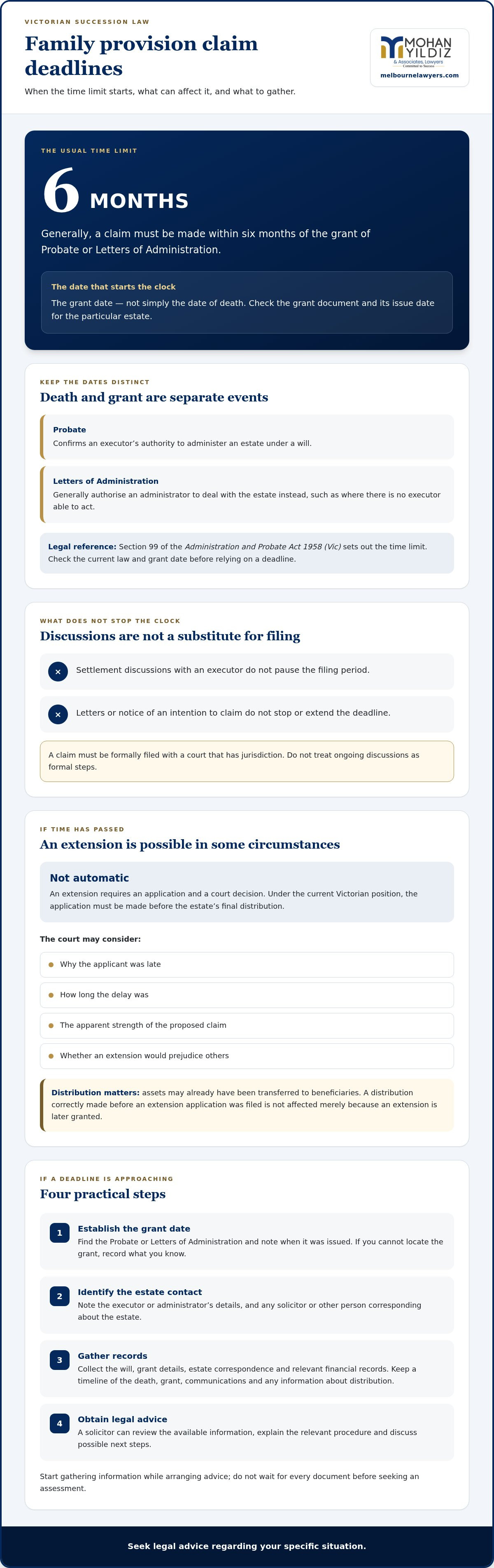
The usual deadline is six months from the date Probate or Letters of Administration is granted, not simply six months from the person’s death. Section 99 of the Administration and Probate Act 1958 (Vic) sets out the time limit. Check the grant date and current statutory position for the particular estate before relying on a deadline.
Which date matters for a Victorian family provision claim?
Generally, a family provision claim must be made within six months of the grant of Probate or Letters of Administration, subject to checking the current law and the grant date for the particular estate.
The date of death and the date of the grant are separate events. If the grant is issued some time after the death, it is generally the grant date that starts the six-month period. Don’t estimate the deadline from the death certificate or assume the grant was made soon after the death. Find the grant document and note its issue date, then get advice about how the time limit applies.
Probate confirms an executor’s authority to administer an estate under a will. Letters of Administration are generally granted when an administrator is authorised to deal with the estate instead, such as where there is no executor able to act. The grant document or estate records can help establish which grant was made and when. If you’re unsure, have the documents reviewed rather than relying on an informal estimate.
What is a family provision claim?
A family provision claim is an application seeking further provision from a deceased person’s estate. It concerns whether adequate provision has been made for the applicant from the estate. It is not automatically a challenge to whether the will is legally valid. A dispute about the will’s validity, such as whether it should be recognised as the deceased person’s will, is a different issue and may involve different considerations.
To understand the family provision claim time limit VIC, identify both the type of issue and the relevant grant. Mohan Yildiz & Associates provides wills and probate services and can review estate documents and explain how the rules may apply. Seek legal advice about your specific situation.
What can affect the Victorian family provision claim deadline?
The deadline isn’t automatically paused because you’re speaking with an executor or trying to reach an agreement. The Administration and Probate Act 1958 (Vic) allows the court to extend the time in some circumstances, but an extension is not automatic. The reasons for delay, the merits of the proposed claim and the effect on other people may all need to be assessed.
Can the court extend the time limit?
An extension requires an application and a court decision. It isn’t an entitlement, and the outcome depends on the circumstances. Under the current Victorian position, an application for an extension must be made before the estate’s final distribution. The court may consider why you were late, how long the delay was, the apparent strength of your claim and whether an extension would prejudice others. Victoria Legal Aid’s Wills and Estates information provides further general guidance about deceased estates.
Why does estate distribution matter?
As estate assets are distributed, the practical position can change. Property or funds may already have been transferred to beneficiaries. Seeking extra time doesn’t necessarily reverse those steps. A distribution correctly made before the extension application was filed isn’t affected merely because an extension is later granted. This is why both the timing of an application and the estate’s administration stage matter. Don’t assume an extension will restore options after distribution.
Negotiations, letters and notice of an intention to claim don’t stop or extend the filing period. If discussions are under way, don’t treat them as a substitute for taking formal steps. The family provision claim time limit VIC and the effect of estate distribution depend on the documents and circumstances. If you’re concerned about timing, you can discuss your estate matter and seek legal advice about your specific situation.
Steps to take if a Victorian family provision deadline is approaching
Work through these steps promptly. Start gathering information while arranging legal advice, but don’t wait for every document before getting an assessment. The family provision claim time limit VIC can depend on the grant date and the estate’s current stage of administration.
- Establish the grant date. Find the Probate or Letters of Administration and note the date it was issued. If you can’t locate the grant, record what you know and explain this when seeking advice.
- Identify the estate contact. Note the executor or administrator’s name and contact details, along with any solicitor or other person corresponding about the estate.
- Gather records. Collect the will, grant details, estate correspondence and relevant financial records. Keep a simple timeline of the death, grant, communications and any information you have about distribution.
- Obtain legal advice. A solicitor can review the available information, explain the relevant procedure and discuss possible next steps.
What information should you gather first?
Start with the documents and messages already available. Include letters or emails about estate assets, proposed distributions or payments, as well as financial records that may help explain your circumstances and the provision made for you. Keep originals safe and make a clear note of missing documents. Their absence doesn’t prevent you from seeking advice.
Wills and probate advice can help clarify the estate records and timing. You can read about the firm’s wills and probate services as you prepare. A plain-English wills and estates guide may also help you understand the documents, but general information can’t assess your particular position.
What if the usual time limit may have passed?
Seek advice promptly. The court may be able to extend the time in some circumstances, but an extension isn’t automatic, and the stage of distribution matters. Don’t assume the claim is automatically barred or that an extension will be granted. Contacting the executor or discussing settlement doesn’t replace filing a claim or an extension application. Seek legal advice about your specific situation.
Getting advice about a family provision claim in Victoria
General information can explain the usual rules, but it can’t determine how they apply to your estate matter. Advice based on your documents and circumstances can help clarify the grant date, the estate’s administration status, the relevant court procedure and practical next steps. It can also identify details that need to be checked before you decide what to do.
What can a first discussion help clarify?
A discussion can focus on the key facts: what grant was issued and when, who is administering the estate, what provision the will makes, and whether the estate has been distributed. You can also explain your relationship to the deceased and the circumstances you believe are relevant to your claim.
The possible path depends on the evidence and the current procedural position. Correspondence from an executor may help establish whether administration is ongoing, while the will and financial records can provide context for assessing your circumstances. No general guide can predict what a court will decide. A solicitor can explain the issues in plain English and identify information that may still be needed.
How the firm approaches estate matters
Principal Solicitor Mohan Yildiz handles matters directly and brings over 30 years of Victorian legal experience. The firm provides plain-English advice based on the records and dates you provide, helping you understand the issues and possible next steps. Its offices are in Broadmeadows and Chadstone. The firm serves clients across Melbourne, including Essendon, Maribyrnong, Moonee Ponds, Pascoe Vale, Glenroy, Bentleigh, Broadmeadows, Chadstone and Craigieburn, and also serves clients in Shepparton by appointment. Consultations can also be arranged at co-working venues across Melbourne by appointment. Turkish-language services are available.
Before deciding what to do, make sure you understand the proposed steps and how they relate to your circumstances. We agree our fees with you in advance.
For advice about the grant, estate status, procedure and options that may apply to you, seek legal advice about your specific situation.
Take a clear next step with your estate matter
Uncertainty about a family provision claim can make it hard to decide what to do next. You don’t need to resolve every question before asking for guidance. A focused review of the documents and your circumstances can help clarify what needs attention first.
The family provision claim time limit VIC is only one part of assessing your position. Your connection to the deceased, the estate records and the current stage of administration may also be relevant. Keep copies of important documents and note the questions you want answered, so the discussion can focus on what matters to you.
If you’re unsure how to proceed, seek legal advice about your specific situation. A careful assessment can help you understand your options and make an informed decision.
Seek legal advice about your specific situation before deciding what to do next.
Frequently Asked Questions
Does the six-month time limit for a Victorian family provision claim run from the date of death?
No. The general six-month period is usually calculated from the date Probate or Letters of Administration is granted, rather than the date of death. Check the grant document or estate records for the issue date instead of estimating from death or funeral records. The family provision claim time limit VIC should be checked against current law and the particular estate. Seek prompt legal advice before relying on a general summary.
Can an adult child make a family provision claim in Victoria?
Yes. An adult child of any age is an eligible person under section 90 of the Administration and Probate Act 1958 (Vic). However, eligibility does not guarantee an order. The Court considers all the circumstances, including the extent to which an adult child can provide for their own proper maintenance and support.
Is a family provision claim the same as challenging the validity of a will?
No. A family provision claim seeks further provision from an estate, while a validity challenge disputes whether the will is legally valid. The issues and evidence involved in disputing whether a document is a valid will differ from those relevant to seeking provision. A provision claim doesn’t automatically invalidate a will. Legal advice can help identify the appropriate process for your concern.
Can an estate be distributed while a family provision claim is being considered?
Estate administration or distribution can affect your practical and legal position, so don’t assume assets will remain untouched while you make enquiries. The effect depends on the estate’s circumstances and current law. Find out whether any assets have been transferred and when, then seek prompt legal advice about the grant, distribution status and steps that may be available in your specific situation.
Disclaimer
This article is general information only and is not legal advice. Laws change, and every situation is different. Contact Mohan Yildiz & Associates for advice about your circumstances.


