

What if the person you had a disagreement with doesn't want an intervention order, but the police decide to apply for one anyway? It's a common and deeply stressful situation to find yourself in. You might feel like you've lost control over your life when Victoria Police step in. Understanding What Happens If Police Apply for an Intervention Order Against You? is the first step towards regaining clarity. When the state initiates this process, the rules change, and the matter is no longer just a private dispute between two people.
You're likely worried about seeing your children or whether an order will impact your future employment. It's natural to feel anxious about being removed from your home or facing a criminal record. Drawing on over 30 years of Victorian court experience, we explain the legal process from the first mention date to final orders. We'll explore how these applications interact with parenting arrangements under Australian family law, though you should always seek legal advice regarding your specific situation.
Key Takeaways
- Learn how a Family Violence Safety Notice acts as an immediate legal order and why Victoria Police can proceed with an application even without the affected person's consent.
- Gain clarity on What Happens If Police Apply for an Intervention Order Against You?, including the purpose of the first mention hearing and your obligations at court.
- Clarify your legal options, such as consenting to an order without admissions or preparing a defence for a contested hearing, to protect your rights and future employment.
- Understand how Victorian intervention orders interact with parenting arrangements in the Federal Circuit and Family Court of Australia and why you should seek legal advice regarding your specific situation.
Understanding a Police-Initiated Intervention Order
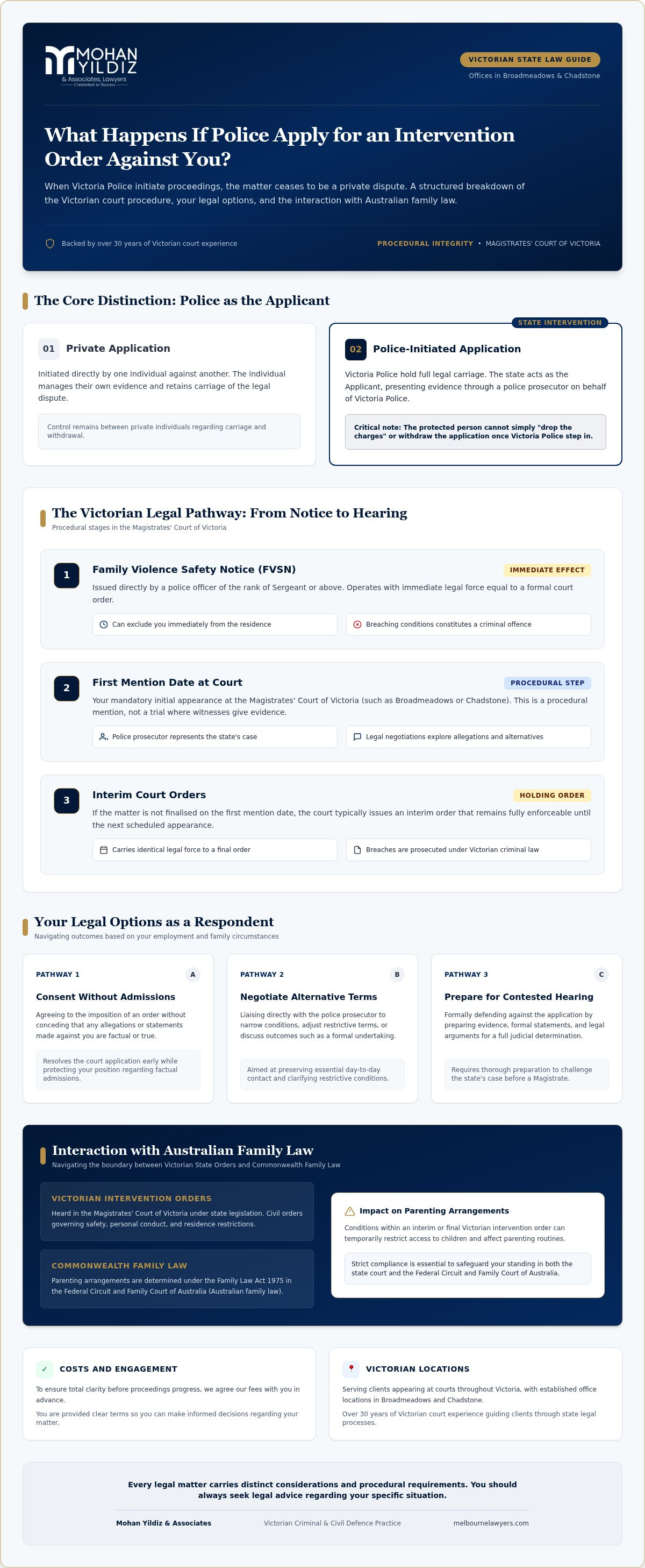
In Victoria, an intervention order is a civil matter designed to protect individuals from harm or fear. When Victoria Police decide to intervene, they take on the role of the "Applicant". This means the legal process is no longer a private dispute between two people; it's a matter managed by the state. Understanding What Happens If Police Apply for an Intervention Order Against You? starts with recognising that the police now have the "carriage" of the case, giving them significant control over how it proceeds.
The Role of the Police as the Applicant
Because the police are the ones making the application, they're responsible for the evidence and the arguments presented in court. A common point of confusion is whether the "Protected Person" can simply "drop the charges" or withdraw the application. Under Victorian law, they generally cannot. The police can, and often do, proceed with the application even if the person they're seeking to protect doesn't want the order to go ahead. This is a critical distinction from private applications and often requires careful navigation of both state law and federal legislation, such as the Family Law Act 1975, which governs parenting arrangements.
Immediate Consequences of an FVSN
The process often begins with a Family Violence Safety Notice (FVSN). This is an immediate, short-term order issued by a police officer of the rank of Sergeant or above. A Family Violence Safety Notice is legally enforceable and can include conditions excluding you from your home or prohibiting contact with certain people. Breaching its conditions can constitute a criminal offence. Strict compliance is essential. While the intervention order itself is civil, breaching a safety notice is a criminal offence. If you're facing these circumstances, it's vital to understand how criminal law principles might affect your situation and your future. We always recommend you seek legal advice regarding your specific situation.
The Court Process: What to Expect at Your First Mention
If you've received a summons, you're required to attend the Magistrates' Court of Victoria on the date listed. Whether your matter is at Broadmeadows or another Victorian court, this first hearing is called a "Mention". The mention is an opportunity for the court to see if the matter can be resolved early. When you're wondering What Happens If Police Apply for an Intervention Order Against You?, it helps to know that a police prosecutor will be there to present the state's case. They act on behalf of the police, not the person seeking protection. The courtroom environment can be intimidating. However, the mention isn't a trial where witnesses give evidence. It's a procedural step to manage the case flow.
Liaising with the Police Prosecutor
Your legal representative will spend time at court speaking with the prosecutor to clarify the specific allegations against you. These negotiations are vital. They can sometimes result in more manageable conditions or alternative outcomes, such as an undertaking. With over 30 years of Victorian court experience, we understand how to navigate these discussions effectively. For more information on your choices, the Victoria Legal Aid respondent options guide provides a clear overview of the statutory process. If you're unsure how to proceed, you can contact our office to arrange a time to speak with our principal directly.
The Impact of Interim Orders
If the matter is not finalised at the first hearing, the Court may make or continue an interim intervention order if the statutory requirements are satisfied. An interim order may remain in force beyond the next hearing until it is revoked or otherwise ceases to operate. It's critical to remember that an interim order carries the same legal weight as a final one. You must follow every restriction, even if you feel the allegations are unfair. Breaching an interim order is a criminal matter. These conditions can also temporarily affect parenting arrangements, so compliance is the only way to protect your standing. We always recommend that you seek legal advice regarding your specific situation.
Your Legal Options as a Respondent
When considering What Happens If Police Apply for an Intervention Order Against You?, you have several legal pathways. It's a mistake to assume you must simply agree to whatever the police prosecutor suggests. Your choice depends on your circumstances, your future career, and your family situation. We agree our fees with you in advance so you can make informed decisions.
Consenting Without Admissions
Choosing to consent "without admissions" is a common way to resolve these matters. It means you allow the order to be made but don't agree that any of the allegations against you are true. This approach avoids a long, drawn-out hearing. However, it's vital to understand that the resulting intervention order is a legally binding document. Even if you didn't admit fault, a breach is still a criminal offence. For a detailed look at your choices, you can review the options for responding to a family violence intervention order provided by Victoria Legal Aid.
Preparing for a Contested Hearing
If you believe the order shouldn't be made at all, you can contest the application. This path leads to a contested hearing, which is essentially a trial. At a contested hearing, the Court considers evidence from the parties and relevant witnesses. Before the hearing, the Court may give directions about filing and exchanging evidence. Principal Mohan Yildiz handles all matters directly, using over 30 years of Victorian court experience to help organise your defence. We work from our Broadmeadows and Chadstone offices.
While some people think they should just agree to an order to make the problem go away, this requires careful thought. An order can impact your firearms licence or your ability to work in certain sectors. It's vital to understand What Happens If Police Apply for an Intervention Order Against You? before making a decision that affects your future. It also carries weight when the Federal Circuit and Family Court of Australia considers parenting arrangements under Australian family law. Undertakings are another option, though they're rarely accepted by police prosecutors.
We always suggest that you seek legal advice regarding your specific situation.
Long-Term Consequences and Australian Family Law
Beyond the immediate court date, it's vital to consider the lasting impact of a police-led application. When you're trying to figure out What Happens If Police Apply for an Intervention Order Against You?, it's important to look at the broader picture. If an order is made, you may be deemed a "prohibited person" under Victorian firearms legislation. This has serious implications for anyone requiring a licence for work or recreation. Similarly, those in nursing, teaching, or security may find their employment status or professional registration under review.
Parenting Arrangements and the IVO
A state-based intervention order can significantly alter parenting arrangements. While these orders are made in the Magistrates' Court, they must interact with any orders from the Federal Circuit and Family Court of Australia. An IVO might limit your time with children or require supervised contact. Where children are involved, any proposed contact arrangements must be considered carefully alongside existing parenting orders, the intervention order conditions and the safety of those affected. We take a calm, non-adversarial approach to these issues, mindful of how the intervention order may affect any related family law matter.
Seeking Professional Legal Support
Having a legal representative who understands the nuances of both Victorian state law and Australian family law is essential. At our boutique practice, Principal Mohan Yildiz handles your matter directly. This ensures you receive personal attention from a practitioner with over 30 years of Victorian court experience. We agree our fees with you in advance, providing certainty during what is often a very stressful period. Understanding the full scope of What Happens If Police Apply for an Intervention Order Against You? involves preparing for how it influences your life years down the track. Whatever Victorian Magistrates' Court your matter is listed at, we provide legal advice and representation appropriate to your circumstances. We always suggest that you seek legal advice regarding your specific situation.
Protecting Your Rights and Future
Finding yourself served with a court summons is a significant life event that requires a methodical response. We've explored how Victoria Police take carriage of these matters and the long-term impacts on your career and parenting arrangements. Understanding What Happens If Police Apply for an Intervention Order Against You? is about more than just the first court date; it's about safeguarding your reputation and your rights for the years ahead.
With over 30 years of Victorian legal experience, we provide plain-English advice to help you navigate these complex situations. Whether you choose to consent without admissions or contest the application, having the Principal Solicitor handle your case directly ensures you aren't just another file in a system. We agree our fees with you in advance so you can focus on achieving a clear resolution without financial uncertainty.
You don't have to face this process alone. Taking the right steps now can make a meaningful difference to your peace of mind and your family's future. We always suggest that you seek legal advice regarding your specific situation.
Frequently Asked Questions
Can I go to jail for an intervention order in Victoria?
An intervention order is a civil order, meaning you won't go to jail simply because one is made against you. However, breaching any condition is a criminal offence under Victorian law. If you're found guilty of a contravention, the court can impose penalties including community correction orders or imprisonment. This is why strict compliance is vital from the moment you're served with a safety notice or interim order.
Will an intervention order show up on my National Police Check?
A final intervention order is a civil matter and won't appear as a criminal conviction on a standard National Police Check. If you are found guilty of breaching an intervention order, the Court may record a conviction or make an order without conviction. Whether the offence appears on a particular police check depends on the applicable disclosure rules. The civil order itself can still matter for specific employment; security licensing and working with children checks may be affected by the civil order.
What happens if the protected person wants to see me but the order says no contact?
You must strictly follow the order conditions, even if the protected person invites you to meet or sends friendly messages. The person seeking protection doesn't have the legal authority to override a court order or a police safety notice. If you contact them in violation of the order, you can be charged with a criminal offence, regardless of their consent. Only the court has the power to vary these conditions.
Can I still live in my house if there is a police intervention order against me?
Whether you can remain at home depends on the specific conditions in the order or safety notice. Police often include an "exclusion condition" in family violence matters, which requires you to leave the premises immediately, even if you own the property. This can mean immediate removal from your home, so get legal advice promptly about the conditions that apply to you.
How long does a police-initiated intervention order usually last?
The duration of a final family violence intervention order depends on the applicable legislation and the Court's decision. The Magistrate may specify how long the order remains in force. You must comply with its conditions until the order expires or is varied or revoked by the Court. Seek advice about the duration stated in your particular order.
Disclaimer
This article is general information only and is not legal advice. Laws change, and every situation is different. Contact Mohan Yildiz & Associates for advice about your circumstances.


