

Imagine sitting across from your former partner, finally reaching an agreement on the house and the kids, only to wonder if that handshake will still mean something in six months. It's a common worry that keeps many people awake at night during a separation. You've done the hard work of finding common ground, but the fear that the other party might change their mind or that a verbal agreement isn't enough to protect your assets is completely understandable. The administrative side of the Federal Circuit and Family Court of Australia often feels overwhelming when you're already dealing with the emotional weight of a breakup.
This guide provides a clear, plain-English path to securing consent orders, allowing you to make your family law agreements legally binding and final without the stress of a court hearing. With over 30 years of Victorian court experience, we understand how to navigate this process with a calm, non-adversarial approach. We'll explore how these orders provide certainty for your parenting arrangements and protect your financial future, ensuring your agreement meets the court's requirements for finality. By the end of this article, you'll understand how to turn your private agreement into a protective shield for your family's future. You should seek legal advice regarding your specific situation.
Key Takeaways
- Learn how to formalise your separation agreements so they become legally binding without the need for a stressful court hearing.
- Understand how consent orders provide a final, enforceable framework for both your property settlement and parenting arrangements.
- Discover why full financial transparency is a mandatory requirement for the Court to approve your agreement as just and equitable.
- Find out how professional oversight ensures your paperwork meets strict administrative standards and avoids common filing pitfalls.
You should seek legal advice regarding your specific situation.
Table of Contents
What are Consent Orders and why are they necessary?
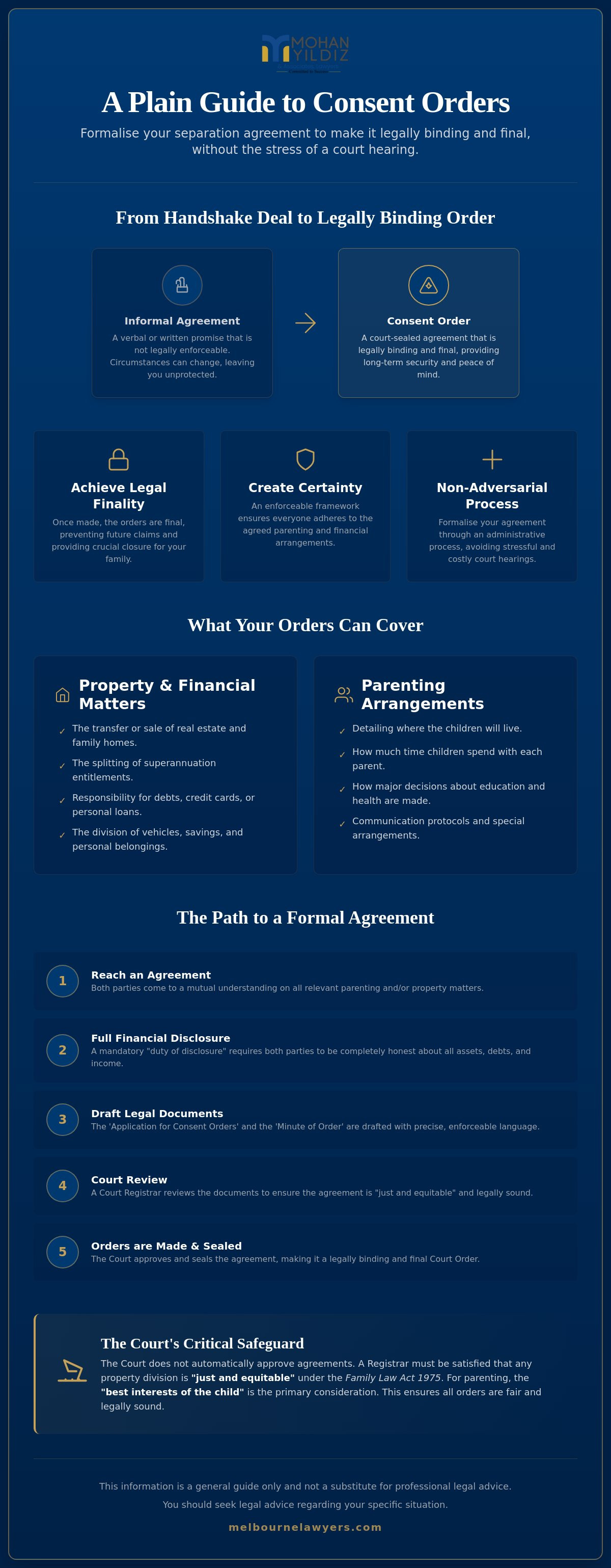
When you and your former partner reach an agreement, it's often a moment of immense relief. However, a verbal promise or a simple written note doesn't provide the legal protection you need to move forward with certainty. In the context of family law, consent orders are a formal written agreement that has been approved and sealed by the Court. This process turns your private arrangement into a court order without the need for you to attend a stressful hearing or engage in an adversarial process.
It's a common mistake to rely on a "handshake deal" simply because things feel amicable right now. Relationships and circumstances can change, and without a formalised document, there's nothing stopping either party from walking away from the agreement later. Consent orders provide a clear, enforceable framework that ensures everyone sticks to the plan you've worked hard to create.
The importance of legal finality
Achieving finality is one of the most significant benefits of this process. Once the orders are made, they are legally binding and carry the same weight as an order made by a judge after a trial. This means you can move forward with your life knowing that your property settlement is secure and your parenting schedule is fixed. It prevents one party from making fresh claims on assets years down the track or suddenly deciding to change school arrangements without your input. This sense of closure is vital for your long-term peace of mind and financial security.
Parenting vs Property Consent Orders
You can use these orders to cover a wide range of practical issues. For parenting matters, they often detail where the children will live, how much time they spend with each parent, and how major decisions about their education and health are made. This aligns with the broader principles of Australian parenting law, which prioritises the best interests of the child on a case-by-case basis.
When it comes to property, the orders provide a meticulous breakdown of how your assets and liabilities are divided. This includes:
-
The transfer or sale of real estate and family homes.
-
The splitting of superannuation entitlements.
-
Responsibility for existing debts, credit cards, or personal loans.
-
The division of vehicles, savings, and personal belongings.
Every family situation is unique, and you should seek legal advice regarding your specific situation to ensure your agreement is drafted correctly and provides the protection you deserve.
The process of applying for Consent Orders in Victoria
Applying for consent orders in Victoria is primarily an administrative process. You don't usually need to step foot in a courtroom or face a judge. Instead, the process involves filing two main documents through the Commonwealth Courts Portal: the Application for Consent Orders and the proposed Minute of Order. While the application form provides the Court with necessary background facts and financial details, the Minute of Order contains the specific terms you want the Court to enforce. For a clear definition of these documents, you can review this guide on What are Consent Orders and how they function within the legal system.
Transparency is the foundation of a successful application. Both parties have a strict "duty of disclosure," which means you must be completely honest about your financial positions. This includes disclosing all assets, debts, and income. If you're unsure how to compile this information, you can reach out for guidance to ensure your application is thorough. Once your documents are submitted, a Registrar reviews the material to ensure everything is in order. They act as a steady safeguard, checking that the agreement is fair and legally sound before it is formalised.
The "Just and Equitable" test
The Court won't simply approve any agreement you submit. For property matters, the Court must be satisfied that the division of assets is "just and equitable" under the Family Law Act 1975. The best interests of the child serve as the primary consideration for all parenting orders.
Drafting the Minute of Order
Precision is vital when drafting your orders. Vague language can lead to confusion or disagreements years down the track, which is why the wording must be clear and enforceable. Having a solicitor with over 30 years of Victorian court experience ensures your Minute of Order meets the Court's rigorous standards. This meticulous attention to detail helps prevent future disputes and provides the long-term certainty your family needs. Every family's circumstances are different, and you should seek legal advice regarding your specific situation.
Consent Orders vs Binding Financial Agreements
Choosing between consent orders and a Binding Financial Agreement (BFA) is a pivotal decision for your future security. The primary difference lies in the level of oversight. While a BFA is a private contract between two parties, consent orders are reviewed and approved by the Court. This judicial review ensures the agreement is fair and equitable, which makes it significantly more difficult for one party to challenge or "set aside" the arrangements years later. For most families in Melbourne, this added layer of court approval provides a level of certainty that a private contract simply cannot match.
The legal requirements for each also differ. By law, a BFA cannot be signed without both parties receiving independent legal advice and obtaining a signed certificate from their respective solicitors. While we always recommend seeking legal advice for orders, the process is technically different because the Court itself acts as a final safeguard. This often makes consent orders a more cost-effective and straightforward option for couples who have already reached a peaceful consensus through mediation or direct discussion.
When to choose Consent Orders
For parenting matters, these orders are the standard choice. They ensure the arrangements are focused on the best interests of the children and are easily enforceable if the schedule isn't followed. In property settlements, they offer practical financial benefits. In Victoria, a sealed court order can often facilitate stamp duty exemptions when transferring property between partners, saving you significant costs during an already expensive transition.
The role of mediation
Mediation is often the most effective tool for reaching the agreement required for these orders. It allows you to resolve disputes in a calm, non-adversarial environment. To understand how this fits into the bigger picture, you may find it helpful to read A Compassionate Guide to Navigating Family Law in Australia. Building a foundation of mutual agreement through mediation makes the administrative filing process much smoother.
Every family's circumstances are different, and you should seek legal advice regarding your specific situation.
How professional support ensures a smooth application
Navigating the administrative requirements of the Federal Circuit and Family Court of Australia can feel like a daunting task when you're already managing the emotional transition of a separation. While the process for consent orders is designed to be accessible, the paperwork is meticulous and leaves little room for error. Having a dedicated solicitor manage these requirements provides more than just technical support; it offers a steady foundation of safety and reliability. We prioritise personal attention and plain-English advice, ensuring you remain informed and protected throughout every step of the application.
With over 30 years of experience in Victorian courts, our principal solicitor understands the nuances of the Court's requirements, ensuring your application is prepared accurately the first time.
Frequently Asked Questions
Do I have to go to court to get consent orders?
You don't typically need to attend court in person to obtain consent orders. The process is handled administratively by a Registrar who reviews your filed documents. As long as the agreement is drafted correctly and meets the legal requirements for being just and equitable, the Court can seal the orders without a formal hearing. This allows you to formalise your arrangements without the stress of a courtroom appearance.
How long does it take for the Court to approve consent orders in Victoria?
Once your application is lodged through the Commonwealth Courts Portal, processing times vary depending on the Court's current workload. Ensuring your paperwork is meticulously prepared from the start helps avoid unnecessary delays.
Can consent orders be changed once they are made?
Yes, orders can be changed, but there's a high threshold for doing so if both parties don't agree. If you both agree to the changes, you can apply for a new set of consent orders to replace the old ones. However, if there's a dispute, the Court will only consider an application to vary the orders if there has been a significant change in circumstances since the original orders were made.
What happens if the other person doesn’t follow the consent orders?
Because these orders are legally binding, failing to follow them is considered a contravention of a court order. If one party doesn't comply with the agreed terms, the other party can apply to the Court for enforcement. Depending on the situation, the Court has several options to ensure compliance, including ordering make-up time for parenting or imposing bonds to encourage future cooperation.
Is a consent order the same as a divorce?
No, a consent order and a divorce are two separate legal processes. A divorce order officially ends your marriage, while these orders settle the practical details of your separation, such as property division and parenting arrangements. You don't need to be divorced to apply for them; many couples choose to formalise their agreements long before applying for a divorce.
Every family's circumstances are different, and you should seek legal advice regarding your specific situation.
Disclaimer
This article is general information only and is not legal advice. Laws change, and every situation is different. Contact Mohan Yildiz & Associates for advice about your circumstances.


