

What if the person who helped you build your vision is now the biggest threat to its survival? When a partner wants to leave the business in Australia, it's natural to feel a sense of uncertainty about the future of your organisation. You've likely invested years of effort into this partnership; seeing it change can feel like the ground is shifting beneath you. It’s a stressful time, but you don't have to navigate these complexities alone.
You deserve a clear, steady path forward that protects your hard work and personal financial security. We'll show you how to manage this transition with clarity. You'll discover the essential legal steps, documentation requirements, and protection strategies needed to safeguard your interests and ensure business continuity. We'll walk through the Victorian legal framework, from valuing the business to formalising the exit. This guide provides a methodical approach to resolving disagreements and securing your peace of mind while we agree our fees with you in advance. You should seek legal advice regarding your specific situation.
Key Takeaways
- Identify the legal distinction between a partnership and a proprietary limited company to understand the specific rules governing the departure.
- Review your governing documents for notice periods and buy-out clauses that protect the ongoing stability of your organisation.
- Learn how to manage valuations and negotiations when a partner wants to leave the business in Australia to achieve a fair and transparent result.
- Ensure all regulatory notifications are completed through a formal exit process, and always seek legal advice regarding your specific situation.
Understanding Your Position When a Business Partner Decides to Exit
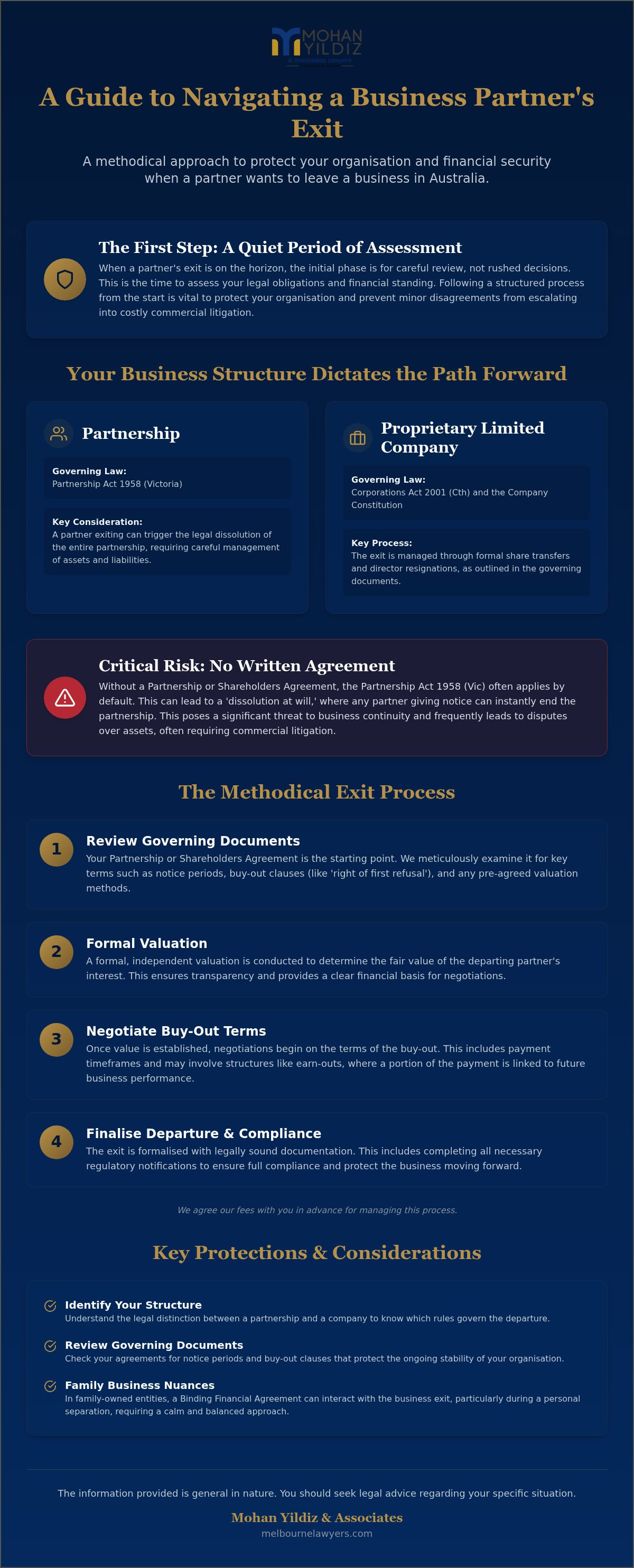
When a partner wants to leave the business in Australia, the first step is to recognise that this is a formal legal transition. It doesn't matter if the departure is amicable or the result of a heated dispute; you must follow a structured process to protect your organisation's future. This initial phase is your quiet period. It is the time to assess your current financial standing and legal obligations without making rushed commitments or verbal promises. Taking this moment to breathe allows for a meticulous review of your position and ensures that no details are overlooked. Early, plain-English advice is vital during this stage. It often prevents a minor disagreement from escalating into costly commercial litigation that could drain your resources.
Identifying Your Business Structure and Governing Law
Your business structure dictates the rules of engagement for the departure. If you operate as a partnership, your actions are primarily governed by the Partnership Act 1958 (Victoria). In many cases, a partner exiting can trigger the legal dissolution of a partnership. This requires a careful, step-by-step approach to ensure all assets and liabilities are accounted for correctly. Conversely, if you operate a proprietary limited company, the Corporations Act 2001 and your company constitution set the framework for share transfers and director resignations.
Family-run businesses often face additional layers of complexity. There may be a significant overlap with Australian family law, especially if the business interests are part of a broader property settlement or separation. Understanding these boundaries helps you maintain business continuity while managing personal changes with empathy. We handle these matters directly to ensure every detail is addressed, and we agree our fees with you in advance. You should seek legal advice regarding your specific situation.
Reviewing Your Governing Documents and Legal Obligations
When a partner wants to leave the business in Australia, your Partnership Agreement or Shareholders Agreement is the first place to look. These documents provide the legal framework for the exit. We meticulously examine these for notice periods, 'shotgun' clauses, or a right of first refusal. A right of first refusal ensures you have the opportunity to buy the departing partner's interest before it's offered to outsiders. Maintaining absolute transparency regarding business assets and liabilities is non-negotiable during this review. It builds trust. It also reduces the chance of future disputes. We agree our fees with you in advance to review these documents thoroughly, ensuring you understand every obligation from the outset.
What Happens if There Is No Written Agreement?
If a written contract is absent, the Partnership Act 1958 (Vic) sets the default rules. This often leads to a 'dissolution at will,' meaning the partnership can be ended instantly by any partner giving notice. Such a scenario can be devastating for business continuity and daily operations. Without clear terms, disagreements over the division of assets frequently escalate into commercial litigation. Our firm has over 30 years of Victorian court experience, which we use to guide you through these default provisions while seeking a practical resolution that avoids the courtroom where possible.
The Role of Binding Financial Agreements in Family Businesses
In family-owned entities, a Binding Financial Agreement often dictates how business interests are treated during a personal separation. These agreements are essential for protecting the organisation's integrity when personal relationships change. The interaction between a separation and a business exit requires a calm, empathetic approach to ensure both personal and commercial interests are balanced fairly. If you need advice about how a business exit may affect your family law property settlement, contact Mohan Yildiz & Associates Lawyers to arrange a consultation at Broadmeadows or Chadstone. You should seek legal advice regarding your specific situation.
Navigating the Exit Process and Protecting Your Interests
When a partner wants to leave the business in Australia, the transition requires a methodical approach to ensure fairness and stability. The process begins with a formal valuation to determine the fair value of the departing partner's interest. Once the value is clear, we move into negotiating the buy-out terms. This includes establishing payment timeframes and exploring potential earn-outs, where a portion of the payment depends on the future performance of the organisation. Our Principal Solicitor handles these negotiations directly, ensuring meticulous attention to every detail of the transaction.
Valuation and Buy-Out Options
We explain valuation methods in plain English so you can make informed decisions. Market value represents what a willing buyer would pay in an open market, while book value looks at the assets' cost minus depreciation. Collaborating with an accounting and advisory practice such as creditte can ensure your company's balance sheet, asset depreciation, and financial records are thoroughly analysed during this stage. A well-drafted Buy-Sell agreement often acts as a pre-planned mechanism for this transition, providing a clear roadmap that reduces friction. By following these steps, we help you maintain focus on your daily operations while we agree our fees with you in advance for the legal work required.
Protecting the remaining business involves more than just a financial settlement. You must address ownership of intellectual property and client lists. We can advise on appropriate restraint clauses, including whether restrictions on competition are reasonable and legally enforceable in the circumstances. Mediation may provide a practical way to resolve a business dispute without litigation. The availability of mediation through the Victorian Small Business Commission depends on the nature of the dispute and its jurisdiction. We can assist with updating business name registration details through ASIC and arranging Victorian land title transfers through an approved electronic lodgment network where required. This approach helps protect your business interests during the transition. You should seek legal advice regarding your specific situation.
Finalising the Departure and Ensuring Future Compliance
Finalising the departure is about more than just a final payment. When a partner wants to leave the business in Australia, you must formalise the end of the relationship to prevent future liabilities. This involves notifying several authorities promptly to ensure the transition is recognised legally. Where a departure involves a change of company director or a relevant change in shareholdings, the company must generally notify ASIC within 28 days. Late notification fees may apply. From 1 July 2026, the applicable standard late fees are $102 for up to one month late and $428 for more than one month late.
A significant change in business ownership is a critical time to review your Wills and Estates. Your business interests are often your most valuable assets. Ensuring they're correctly accounted for in your personal estate planning provides lasting security for your family. We use over 30 years of Victorian legal experience to guide this final settlement, ensuring every administrative detail is handled with meticulous care. Our Principal Solicitor handles these final steps directly, so you have a single point of contact who understands the history of your matter.
Drafting a Formal Deed of Exit
Verbal agreements may be legally binding, but their terms can be difficult to establish or enforce. When informal discussions or unwritten promises are contested, legal support and eDiscovery specialists such as Trustpoint.One highlight how messaging records and chat data increasingly serve as pivotal evidence. Recording a business exit in a carefully drafted written agreement can reduce uncertainty and disputes. A written Deed of Exit or Settlement can record agreed releases, indemnities and other terms, subject to the rights of creditors and other third parties. This document includes essential components like release from liability, indemnity clauses, and confidentiality agreements. A properly drafted deed can document the agreed releases and indemnities, but its effectiveness depends on its terms and the parties bound by it. It does not automatically release a departing partner from liabilities owed to banks, creditors or other third parties. We provide straightforward, plain-English advice to ensure you understand every clause of the document. We agree our fees with you in advance for this work. You should seek legal advice regarding your specific situation.
Securing Your Business Continuity
Managing a transition when a partner wants to leave the business in Australia requires a methodical approach and a steady hand. You now understand the importance of reviewing your governing documents and conducting a formal valuation to protect your organisation's financial health. A carefully drafted Deed of Exit can clarify the parties' rights and obligations and reduce the risk of future disputes, although it cannot eliminate every potential claim or liability. Our Principal Solicitor, Mohan Yildiz, handles every matter directly. He brings over 30 years of Victorian court experience to your situation, ensuring meticulous attention to detail. We also offer Turkish-language services to support Melbourne's diverse business community. We agree our fees with you in advance so you have complete clarity on costs.
Obtaining legal advice can help you understand your rights, obligations and risks before finalising a business partner's departure. You should seek legal advice regarding your specific situation.
Frequently Asked Questions
What is the first thing I should do if my partner wants to leave?
Locate and review your governing documents, such as your Partnership Agreement or Shareholders Agreement. This is the foundation for the entire exit process. These documents outline the notice periods and procedures required to maintain business continuity. We handle these reviews directly to identify your immediate obligations. It's a critical step before you make any verbal agreements or financial commitments that could complicate the transition for your Broadmeadows or Chadstone business.
Can I stop my business partner from leaving the business?
Generally, you can't force a person to stay, but you can enforce the terms of your written agreement. When a partner wants to leave the business in Australia, they must comply with the notice periods and exit clauses you both signed. If no agreement exists, the Partnership Act 1958 (Vic) allows for dissolution at will. We help you understand these rules to ensure the departure doesn't unfairly disadvantage your ongoing operations.
How is a departing partner's share valued in Australia?
Valuation is typically determined by the method specified in your governing documents. Common approaches include market value, book value, or a pre-agreed formula. If the agreement is silent, you may need an independent valuation to ensure a fair buy-out price. Our Principal Solicitor manages these negotiations directly to ensure the outcome is transparent. We agree our fees with you in advance for this work to ensure you have complete clarity on costs.
Do I need to notify ASIC if a business partner leaves?
ASIC notification requirements depend on the business structure and the nature of the change. Companies generally must notify ASIC within 28 days of certain changes involving directors or shareholdings. Partnerships have different obligations, including updating relevant business name and taxation records. Late lodgment fees may apply.
What happens to the business debts when a partner exits?
A departing partner may remain personally liable for partnership debts incurred before departure. A deed between the partners does not, by itself, release that partner from obligations owed to external creditors. A creditor's agreement may be necessary to obtain an effective release. Existing guarantees should also be reviewed separately.
Disclaimer
This article is general information only and is not legal advice. Laws change, and every situation is different. Contact Mohan Yildiz & Associates for advice about your circumstances.


