

What happens when the court orders that once provided stability now feel like a barrier to your family's wellbeing? It is common to feel anxious that you're stuck with outdated arrangements, especially when your work schedule shifts or your children's needs change. You might be asking, Can You Change Consent Orders After They Are Made? while fearing that any attempt to do so will lead back to a combative environment. It is completely natural to feel protective of your peace while acknowledging that your current situation is no longer practical.
This guide explains the legal thresholds under Australian family law, including the 2024 legislative changes that codified how the court views a significant change in circumstances. You'll discover how to vary orders through mutual agreement or a court application, ensuring you have a clear path forward. We provide straightforward support, and to ensure you feel secure throughout the process, we agree our fees with you in advance. We'll explore the different requirements for parenting arrangements versus financial orders and the practical steps to update them. You should seek legal advice regarding your specific situation.
Key Takeaways
- Understand that consent orders are legally binding agreements approved by the Federal Circuit and Family Court of Australia, intended to provide long-term stability and finality.
- Identify the legal threshold for a variation to help you determine: Can You Change Consent Orders After They Are Made? when your life circumstances significantly change.
- Learn how to formalise new parenting arrangements or financial agreements through a structured process to ensure your new situation is legally protected.
- Discover how 30 years of Victorian court experience can guide you through these changes while we agree our fees with you in advance. You should seek legal advice regarding your specific situation.
Understanding the Finality of Consent Orders in Australian Family Law
Consent orders represent a significant milestone in your post-separation journey. They are legally binding agreements that have been formally approved and sealed by the Federal Circuit and Family Court of Australia. This process transforms a mutual agreement into a court order, providing a clear framework for your future. When people ask, Can You Change Consent Orders After They Are Made?, it's often because life has taken an unexpected turn. You might wonder if flexibility is possible when a new job or health issue arises.
The legal system prioritises the principle of finality. This means the court prefers that family law matters reach a definitive conclusion so you and your family can move forward with certainty. Understanding the Finality of Consent Orders in Australian Family Law is essential because it highlights the difference between a private agreement and a court-sealed order. A private arrangement lacks the enforceability of a sealed order. Conversely, if you simply ignore a court-sealed order because it has become unworkable, you risk facing contravention proceedings. We understand that these situations are stressful, which is why we provide clear guidance and agree our fees with you in advance to ensure transparency.
Parenting Arrangements vs Property Orders
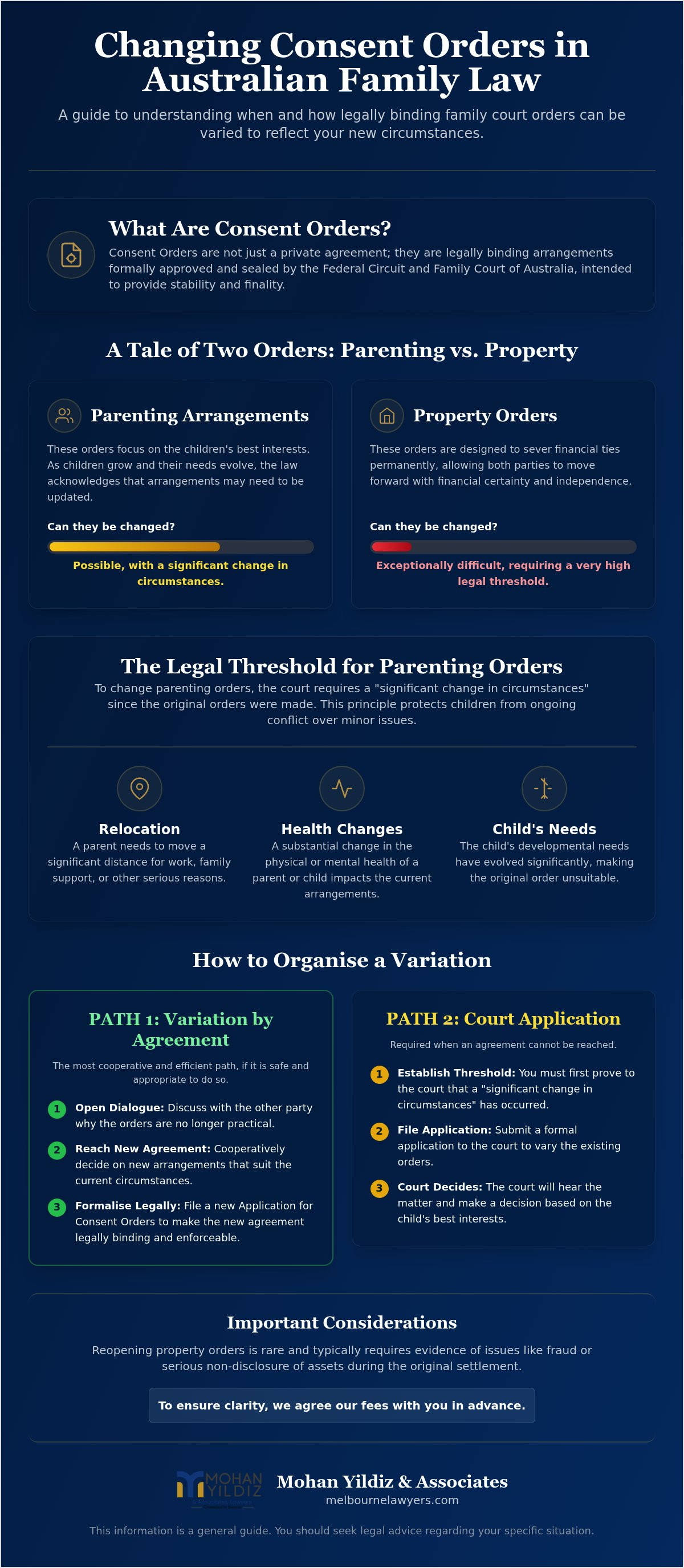
There's a distinct difference in how the law treats variations depending on the subject matter. Parenting arrangements are always centred on the best interests of the child. Because children grow and their needs evolve, the court acknowledges that orders may occasionally require updating to reflect their current reality. Property orders, however, are designed to sever financial ties permanently. Reopening a final property settlement is much more difficult and requires meeting a very high legal threshold. If your circumstances have shifted, exploring your options under Australian family law is a practical first step. You should seek legal advice regarding your specific situation.
The Legal Threshold: What Constitutes a Significant Change in Circumstances?
When families ask, Can You Change Consent Orders After They Are Made?, the answer rests on a specific legal threshold. Under Australian family law, the court follows the Rice v Asplund principle. This rule ensures that parenting orders aren't constantly reopened for minor reasons, protecting children from ongoing conflict. Under section 65DAAA of the Family Law Act 1975 (Cth), the Court must generally be satisfied that there has been a significant change of circumstances since the final parenting order was made before reconsidering it. The Court must also be satisfied that reconsideration is in the child's best interests. The legislation permits reconsideration in certain circumstances by consent.
It's vital to understand that "significant" carries a high burden of proof. Minor frustrations or small timing tweaks usually won't qualify. Instead, the court looks for substantial shifts that fundamentally alter the family dynamic. Common examples include:
- A parent needing to relocate for work or family support.
- Significant changes in the physical or mental health of a parent or child.
- The child's developmental needs changing as they grow from a toddler into a school-aged child.
A significant change in circumstances does not automatically justify changing a parenting order. Under section 65DAAA of the Family Law Act 1975 (Cth), the Court must also consider whether reconsidering the order is in the child's best interests.
When the Court Might Reopen Property Orders
Property orders are intended to be final, allowing both parties to move forward with financial independence. Final property orders can be set aside or varied only on recognised statutory grounds, including circumstances involving a miscarriage of justice arising from fraud, duress, suppression of evidence or other relevant circumstances. Section 79A of the Family Law Act 1975 (Cth) governs married parties, with section 90SN applying to de facto relationships. A later change in financial circumstances does not, by itself, ordinarily justify reopening a final property settlement. If your financial circumstances have shifted drastically, you might need to explore spousal maintenance as a separate consideration rather than trying to vary the property split itself. If you feel your current orders are no longer safe or practical, you can reach out to us for a calm discussion. We prioritise transparency and always agree our fees with you in advance. You should seek legal advice regarding your specific situation.
How to Organise a Variation to Your Existing Orders
Organising a variation requires a methodical approach to ensure the new arrangements are legally sound. When asking, Can You Change Consent Orders After They Are Made?, the most efficient path is usually through mutual cooperation. If it's safe to do so, opening a direct dialogue with the other party allows you to discuss why the current orders are no longer practical. If an agreement is reached, the next step is to formalise it by filing fresh Consent Orders. This prevents future misunderstandings and provides both parties with renewed legal certainty. For parenting matters, a written parenting plan may also be considered. It is not enforceable in the same way as a court order, although it can have legal significance and may affect existing parenting orders in certain circumstances.
If you cannot reach an agreement, the process becomes more formal. For parenting matters, parties generally need to attempt family dispute resolution and obtain a section 60I certificate before filing an Initiating Application in the Federal Circuit and Family Court of Australia, unless a statutory exemption applies, including certain circumstances involving family violence, child abuse or urgency. The Court may also encourage further dispute resolution during proceedings. This ensures that every effort is made to resolve the matter calmly before moving toward a contested hearing.
Varying Orders by Agreement
When both parties recognise that change is necessary, the process is straightforward and significantly less stressful. We can assist by drafting clear, practical orders that reflect your new reality, ensuring they meet the court's requirements for approval. This collaborative approach keeps the focus on your family's wellbeing while we agree our fees with you in advance to provide financial clarity.
Contested Variations in Court
In cases where an agreement isn't possible, the burden of proof rests on the person seeking the change. You must demonstrate to the court that the variation is necessary and, in matters regarding parenting arrangements, serves the child's best interests. Navigating these complexities requires a steady hand and a thorough understanding of Australian family law to ensure your case is presented clearly and effectively. You should seek legal advice regarding your specific situation.
Navigating Variations with Calm and Practical Legal Advice
Seeking a variation can feel like stepping back into a storm you've already weathered. When you're asking, Can You Change Consent Orders After They Are Made?, you need a guide who provides more than just technical answers. Principal Solicitor Mohan Yildiz brings over 30 years' experience in Victorian courts to every matter, ensuring you receive personal attention from a steady hand. We focus on providing plain-English advice so you never feel lost in legal jargon. To give you peace of mind during what is often a stressful time, we agree our fees with you in advance.
Our boutique practice is rooted in the local community, with offices in Broadmeadows and Chadstone. We understand the unique needs of Melbourne families and provide a supportive environment where you can discuss your situation openly. Whether your life has changed due to a new career opportunity or shifting family dynamics, we provide the grounded advocacy required to update your legal framework effectively.
A Non-Adversarial Approach to Family Law
We prioritise a calm, non-adversarial approach to Australian family law. Our goal is to protect relationships and ensure the wellbeing of your children by seeking resolutions that avoid unnecessary conflict. For the local community, we are pleased to offer services in Turkish (Türkçe), ensuring that language is never a barrier to clear communication. Whether you need to update parenting arrangements or revisit financial matters, we are here to help. You can Contact Us to organise an appointment at one of our offices or a convenient co-working space. You should seek legal advice regarding your specific situation.
Securing Your Family's Future with Updated Arrangements
Life doesn't stand still, and your legal arrangements shouldn't either. While finality is a core principle of Australian family law, the system allows for variations when life takes a significant turn. Whether you're navigating a new career path or adapting to your children's developmental milestones, understanding the answer to Can You Change Consent Orders After They Are Made? provides the clarity you need to move forward. By prioritising a calm dialogue, you can often update your parenting arrangements without returning to a combative environment.
Principal Solicitor Mohan Yildiz has over 30 years' experience in Victorian courts and ensures you receive direct principal-to-client contact for every matter. We believe in transparency, which is why we agree our fees with you in advance. This approach ensures you feel protected and informed as you transition into a new chapter.
Updating your orders is a practical step toward long-term stability and relief. You should seek legal advice regarding your specific situation.
Frequently Asked Questions
Can I change my consent orders if my ex-partner and I both agree?
Yes, you can. The most straightforward path is filing a new Application for Consent Orders with the Federal Circuit and Family Court of Australia. This formalises the change and makes it legally binding. While informal agreements are common, they aren't enforceable under Australian family law. We can assist in drafting clear, practical orders that reflect your current needs while ensuring they meet the court's strict requirements for approval.
What happens if I stop following a consent order because it is no longer practical?
Failing to follow a court order can lead to serious contravention proceedings, even if the current terms feel unworkable. The court expects strict compliance until a formal variation is made. If you are asking, Can You Change Consent Orders After They Are Made?, the answer is yes, but you must follow the correct legal process. Proactively updating your orders protects you from potential penalties and provides long-term peace of mind.
How much does it cost to vary a consent order in Victoria?
Costs vary depending on whether the change is agreed upon or contested. To ensure transparency and help you plan, we agree our fees with you in advance and confirm them in writing. This approach avoids the stress of unknown costs during a difficult time. Our boutique firm provides personal attention from our principal solicitor, focusing on achieving a calm and practical outcome for your family across Melbourne.
Can I change property settlement orders years after they were made?
Property settlement orders are intended to be final and are very difficult to reopen. The Court may set aside or vary final property orders on specified statutory grounds under section 79A of the Family Law Act 1975 (Cth), or section 90SN for de facto couples. These grounds include a miscarriage of justice arising from fraud, duress or suppression of evidence, as well as other circumstances specified in the legislation. If your financial circumstances have changed significantly, you might need to explore options like spousal maintenance instead. These matters are governed by Australian family law and require a high legal threshold to vary.
Do I have to go back to court to change my parenting arrangements?
Not necessarily. If both parties agree to the changes, the process is usually handled administratively without a court appearance. You simply file an Application for Consent Orders. However, if there is no agreement, you must apply to the Federal Circuit and Family Court of Australia and demonstrate a significant change in circumstances. We support clients at our Broadmeadows and Chadstone offices to navigate these parenting arrangements calmly.
You should seek legal advice regarding your specific situation.
Disclaimer
This article is general information only and is not legal advice. Laws change, and every situation is different. Contact Mohan Yildiz & Associates for advice about your circumstances.


