

What if the biggest hurdle to your post-separation stability isn't the division of assets, but the day-to-day cost of simply starting over? It's natural to feel a sense of financial insecurity when a relationship ends, especially if you've been the one managing the household or caring for children while your partner focused on their career. You might find yourself confused by the difference between child support and spousal maintenance in Australia, or perhaps you worry that seeking support will lead to an expensive, adversarial court process.
We understand these concerns and are here to provide a clear, compassionate path forward. This guide will help you understand your rights and eligibility under the Family Law Act 1975, ensuring you have the information needed to seek a fair outcome. We'll explore how the law balances your financial needs with your former partner's capacity to pay, the strict time limits for applications in Victoria, and how mediation can help you achieve stability without unnecessary conflict. You deserve to feel secure about your future, and understanding your options is the first step toward that peace of mind.
Key Takeaways
- Understand the distinction between the American term "alimony" and how the law defines financial support for former partners in Victoria.
- Learn how the "Need vs. Capacity" test determines your eligibility for spousal maintenance in Australia by balancing your financial requirements against your former partner's ability to pay.
- Explore the different ways support can be structured, including periodic payments or lump sums, to help you meet your daily living expenses.
- Identify the critical Victorian legal deadlines for applications, including the 12-month rule for divorced couples and the two-year rule for de facto partners.
- Discover the benefits of using mediation to reach a fair, formalised agreement that provides security without the need for stressful court intervention.
Table of Contents
What is Spousal Maintenance in Australia? (Understanding Alimony)
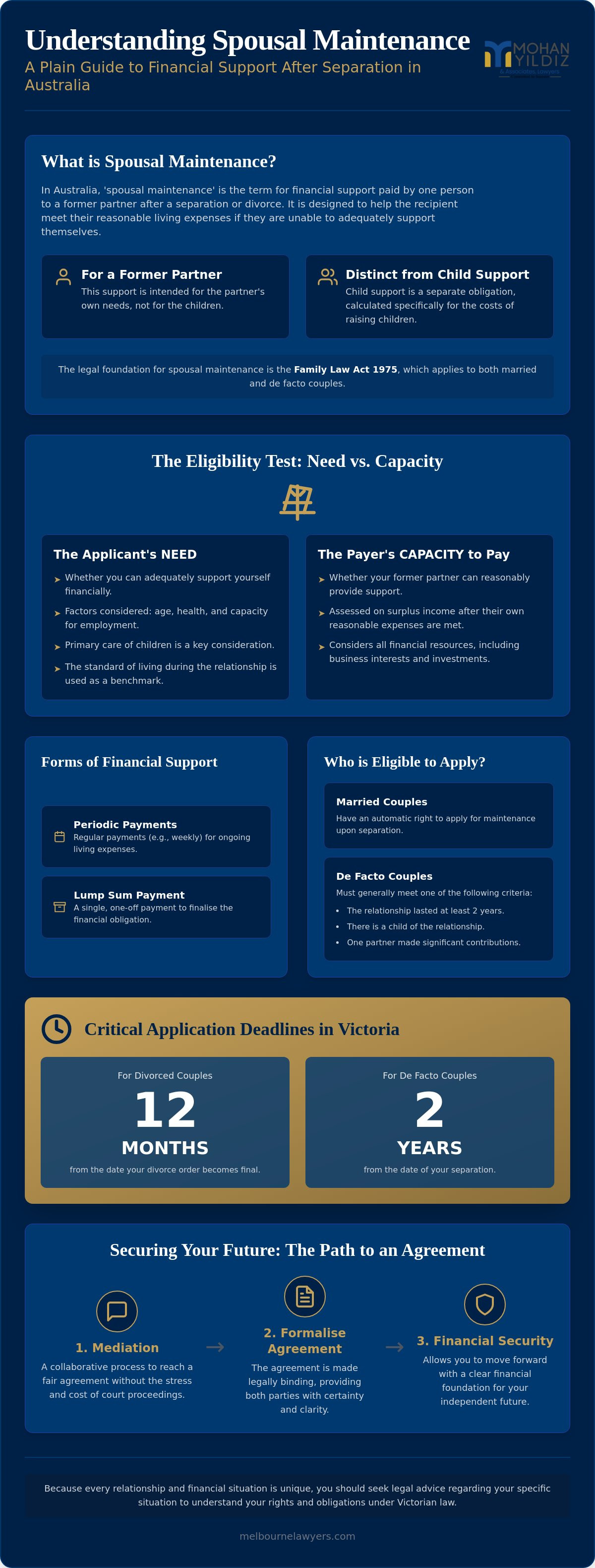
Many people are familiar with the term Alimony from international films and television, but in the Australian legal system, we refer to this financial support as spousal maintenance. It is a provision designed to ensure that if one partner cannot adequately support themselves after a separation, the other partner provides financial assistance. When exploring spousal maintenance Australia, you'll find it is a practical measure grounded in the principle of fairness, focusing on the core purpose of helping both individuals meet reasonable living expenses as they transition into independent lives.
It's vital to recognise that spousal maintenance is distinct from child support. While child support is specifically calculated to cover the costs of raising children, spousal maintenance is intended for the former partner’s own needs. These are separate legal obligations that require different assessments, often involving a detailed look at your daily costs, future requirements, and the lifestyle you shared during the relationship.
The Legal Foundation: Family Law Act 1975
The Family Law Act 1975 provides the framework for how these financial arrangements are handled for both married and de facto couples. Under the Family Law Act 1975, spousal maintenance is the duty of one person to maintain the other to the extent that the first person is reasonably able to do so. Australia operates under a "no-fault" jurisdiction; this means the reasons for the breakdown of the relationship don't affect your eligibility for support. Instead, the focus remains entirely on financial need and the ability to pay.
De Facto vs. Marital Maintenance
While married couples have a right to apply for support upon separation, de facto couples must meet specific criteria to be eligible. Usually, you need to show the relationship lasted at least two years, there is a child of the relationship, or that significant contributions were made that would result in serious injustice if support weren't considered. Establishing that you lived together on a "genuine domestic basis" is a key part of this process. If you are unsure how these rules apply to your circumstances, family law guidance can help clarify your position.
Because every relationship and financial situation is unique, you should seek legal advice regarding your specific situation to understand your rights and obligations under Victorian law.
Eligibility: The 'Need vs. Capacity' Test
Determining eligibility for spousal maintenance Australia involves a two-step evaluation often described as the "Need vs. Capacity" test. As outlined by the Federal Circuit and Family Court of Australia, the court first looks at whether you can adequately support yourself. This threshold test considers your age, your physical and mental health, and your capacity for gainful employment. If you have primary childcare responsibilities for children of the relationship, this naturally impacts your earning capacity and is a primary factor in establishing financial need.
Defining 'Reasonable' Living Expenses
Proving your need requires a clear look at your weekly budget. Reasonable expenses typically include housing, utilities, groceries, health costs, and transport. The court doesn't expect you to live in poverty; instead, the standard of living you enjoyed during the relationship serves as a benchmark for what is considered reasonable. Detailed financial statements are essential here to provide a transparent view of your actual costs. If you're feeling overwhelmed by the paperwork, you can reach out to our team to discuss how to document your position clearly.
Assessing the Payer's Financial Position
The second part of the test focuses on whether your former partner has the ability to provide support. Capacity is determined by what is left over after the payer meets their own necessary costs. This assessment goes beyond simple take-home pay. It includes surplus income and non-cash resources like family trusts, business interests, or investment dividends. The court ensures that any order made is fair and doesn't leave the payer unable to meet their own reasonable living requirements. By looking at the complete financial picture, a balanced outcome can be reached that supports your transition to independence.
Because every financial situation involves different variables, you should seek legal advice regarding your specific situation to ensure your assessment is thorough and accurate.
How is Spousal Maintenance Calculated and Paid?
Unlike the rigid formulas used by the Child Support Agency, there's no fixed calculation for spousal maintenance in Australia. Each case is examined on its own merits, with a focus on the practical realities of your daily life and the specific financial hurdles you face. The primary objective is often rehabilitative. This means the support is intended to assist you in becoming self-sufficient over time, perhaps by providing the financial breathing room needed to complete a university course or re-enter the workforce after a long absence. If you find yourself in immediate financial hardship, you can apply for interim maintenance to cover essential costs while your final property settlement is being resolved.
Periodic Payments for Ongoing Support
Most maintenance arrangements involve periodic payments, typically made weekly or fortnightly. This structure is often helpful for managing recurring bills, rent, and groceries. These payments can be indexed to the Consumer Price Index (CPI) to ensure they keep pace with the rising cost of living. A significant benefit of this approach is its flexibility; if your income or your former partner’s financial situation changes significantly, the arrangement can often be adjusted to reflect those new circumstances.
Lump Sum Maintenance: A Clean Break
In some instances, a one-off lump sum payment may be more appropriate. This approach is often favoured when parties want to achieve a "clean break" and avoid the ongoing contact that regular payments require. According to the Federal Circuit and Family Court of Australia, a lump sum can be paid as part of a final property division. While this provides immediate certainty and reduces the risk of future conflict, it's important to consider how a lump sum might affect your long-term financial planning and tax position.
Because every financial arrangement carries different long-term implications, you should seek legal advice regarding your specific situation to determine which payment structure best serves your needs.
Time Limits and Critical Deadlines in 2026
While the law provides a safety net for those in financial need, your right to apply for spousal maintenance Australia is subject to strict time constraints. For married couples, you must file an application within 12 months of your divorce order becoming final. If you were in a de facto relationship, the window is different; you have two years from the date of separation to make a claim. Missing these deadlines can significantly complicate your path to financial stability, as the court generally requires a compelling reason to hear a late application.
Applying 'Out of Time'
If you've missed your filing deadline, you must seek 'leave of the court' to proceed with your claim. This isn't a simple administrative step. You'll need to prove that you or a child of the relationship would suffer genuine hardship if the application weren't heard. The legal bar for proving hardship is quite high, and the court will also consider the reasons for your delay. Acting promptly after your relationship ends is the most reliable way to protect your financial interests and avoid the stress of proving hardship years later.
When Maintenance Obligations End
Maintenance orders aren't necessarily permanent. They typically conclude when you reach the end of a specified period or achieve the goal of self-sufficiency. However, certain events trigger an automatic end to these obligations. If the person receiving support remarries, the order usually stops immediately. Similarly, entering a new de facto relationship can lead to a review or cessation of payments if your financial position improves. Other factors, such as the death of either party or a significant change in the payer's ability to provide support, can also result in a variation of existing orders.
Because every situation involves unique timelines and life changes, you should seek legal advice regarding your specific situation to ensure your rights are fully protected.
Securing Your Future: The Path to an Agreement
Achieving a sense of financial security after a relationship ends doesn't have to involve a confrontational courtroom experience. Most people find that a structured, collaborative approach leads to more sustainable outcomes. By focusing on reaching an agreement through dialogue rather than dispute, you can establish a foundation of reliability for your new life. While the process of determining spousal maintenance Australia can feel overwhelming, focusing on out-of-court resolutions often results in a fairer and more respectful transition for everyone involved.
Mediation and Collaborative Law
Mediation and family law mediation support provide a neutral, supportive environment where both parties can discuss their financial needs openly. This process is designed to be highly navigable, moving through your financial realities step-by-step with a steady guide to facilitate the conversation. To prepare effectively, you'll need to gather clear documentation of your income, assets, and daily living expenses. This transparency allows for a fair assessment without the adversarial atmosphere of a court hearing, significantly reducing both the emotional and financial costs of your separation.
The Role of Professional Advocacy
While informal "handshake deals" might seem simpler or more amicable at first, they are legally unenforceable and carry significant risks. If circumstances change, a verbal agreement provides no protection. Formalising your arrangement through Consent Orders is the gold standard for ensuring long-term security. These orders are filed with the court and become legally binding, ensuring that the support you've agreed upon remains reliable. Our firm provides the meticulous attention to detail required to ensure your financial need is accurately represented and that you are protected from unfair demands or hidden assets.
Because every family's financial situation and relationship history is unique, you should seek legal advice regarding your specific situation to ensure your rights are fully protected under Victorian law.
Taking the First Step Toward Your Financial Independence
Navigating life after separation requires both emotional resilience and a clear understanding of your financial rights. By focusing on the "Need vs. Capacity" balance and respecting the strict 12-month or 2-year filing deadlines, you can create a stable foundation for your future. Understanding your rights regarding spousal maintenance Australia is vital for securing your long-term stability and ensuring you can meet reasonable living expenses as you transition into this new chapter.
At Mohan Yildiz & Associates, we offer a boutique approach that prioritises your personal well-being. We provide clear guidance on the Family Law Act 1975 with meticulous attention to financial detail, ensuring your situation is represented fairly without resorting to unnecessary conflict. Our goal is to help you reach a binding agreement that provides the safety and reliability you deserve.
You don't have to manage these complex decisions alone. With the right support, you can move forward with quiet confidence and clarity. Because every relationship and financial situation involves unique variables, you should seek legal advice regarding your specific situation to ensure your interests are fully protected under Victorian law.
Common Questions Regarding Spousal Maintenance
Is spousal maintenance the same as alimony?
Conceptually, yes, but the legal terminology differs. While "alimony" is a term commonly used in the United States and seen in international media, the Australian legal system uses the term spousal maintenance. Under the Family Law Act 1975, this refers to the financial support provided by one person to their former partner when that partner cannot adequately support themselves following a separation or divorce.
How long do I have to pay spousal maintenance in Australia?
There is no fixed duration for these payments as they are typically designed as a transitional measure. The goal is often rehabilitative, providing support until the recipient can become self-sufficient, such as after completing a period of study or re-entering the workforce. Orders usually specify an end date or a particular event that triggers the cessation of payments, ensuring the arrangement remains fair for both parties.
Can I get spousal maintenance if I am working?
Yes, you may still be eligible for spousal maintenance Australia even if you have a job. Eligibility is determined by whether your current income is sufficient to meet your "reasonable" living expenses. If your earnings do not cover your basic needs and your former partner has the financial capacity to assist, the court may still find that a maintenance obligation exists to bridge that financial gap.
What happens to spousal maintenance if I remarry?
Maintenance orders generally stop automatically if the person receiving the support remarries. If you enter into a new de facto relationship, the order does not necessarily end immediately, but it often triggers a review. The court will look at your changed financial circumstances and the support provided by your new partner to determine if the existing maintenance order should be varied or discharged.
Do I have to go to court to get spousal maintenance?
No, you do not have to go to court to reach an agreement. Most couples find that mediation and family dispute resolution are effective ways to settle financial support matters without the stress of a trial. Once you reach an agreement, it can be formalised through Consent Orders, which are filed with the court to make the arrangement legally binding and enforceable without requiring a judge to decide for you.
How is spousal maintenance different from child support?
Spousal maintenance is intended to support a former partner, whereas child support is specifically for the costs of raising children. These are two separate legal obligations that are assessed using different criteria. While child support is often managed through a formulaic assessment, spousal maintenance requires a detailed look at the personal financial needs of the adult partner and the other person's ability to provide that support.
Can men apply for spousal maintenance in Australia?
Yes, the law is entirely gender-neutral. Any party to a marriage or a de facto relationship can apply for financial support if they meet the eligibility criteria. The assessment focuses purely on the financial need of the applicant and the capacity of the other person to pay, regardless of their gender or their role during the relationship.
What if my ex-partner refuses to pay the court-ordered maintenance?
If a former partner fails to comply with a formal order, you can seek enforcement through the court system. This process ensures that the obligations set out in your agreement or order are met. Enforcement can include various measures to recover the funds, such as the garnishing of wages. It is important to have a formalised agreement in place to ensure you have clear legal pathways if payments are missed.
Because every financial situation involves unique variables and specific timelines, you should seek legal advice regarding your specific situation to ensure your rights are protected under Victorian law.
Disclaimer
This article is general information only and is not legal advice. Laws change, and every situation is different. Contact Mohan Yildiz & Associates for advice about your circumstances.