

Seeking an intervention order shouldn't feel like entering a battlefield; it's a practical step toward reclaiming your peace of mind and ensuring your family's safety. When you're worried about your personal safety or the wellbeing of your children, the legal system can often feel cold and intimidating. It's completely natural to feel anxious about attending the Magistrates' Court or confused by the difference between family violence and personal safety orders. You aren't alone in feeling this way, and your desire for a resolution that avoids further conflict is entirely valid.
In this guide, you'll learn how Victorian intervention orders work and how to manage the legal process with clarity and calm. We'll explain the court steps in plain English, drawing on over 30 years of experience in Victorian courts to provide the steady guidance you need. We'll explore how these orders affect parenting arrangements and what to expect during your hearing. By the end, you'll have a clear understanding of how to secure legal protection while maintaining a focus on a non-adversarial resolution for your family. This guide provides general information, so it's always important to seek legal advice regarding your specific situation.
Key Takeaways
- Understand how an intervention order acts as a practical legal safeguard to protect your safety and clearly define boundaries in Victoria.
- Navigate the application process at the Magistrates' Court with a clear understanding of how interim orders provide immediate protection in urgent situations.
- Learn to manage the interaction between safety orders and parenting arrangements using a calm, non-adversarial approach that prioritises long-term resolution.
- Discover how over 30 years of Victorian court experience can provide the steady, plain-English guidance needed to ensure your voice is heard.
- Recognise the importance of seeking legal advice regarding your specific situation to navigate the legal process with confidence and clarity.
Table of Contents
What is an Intervention Order in Victoria?
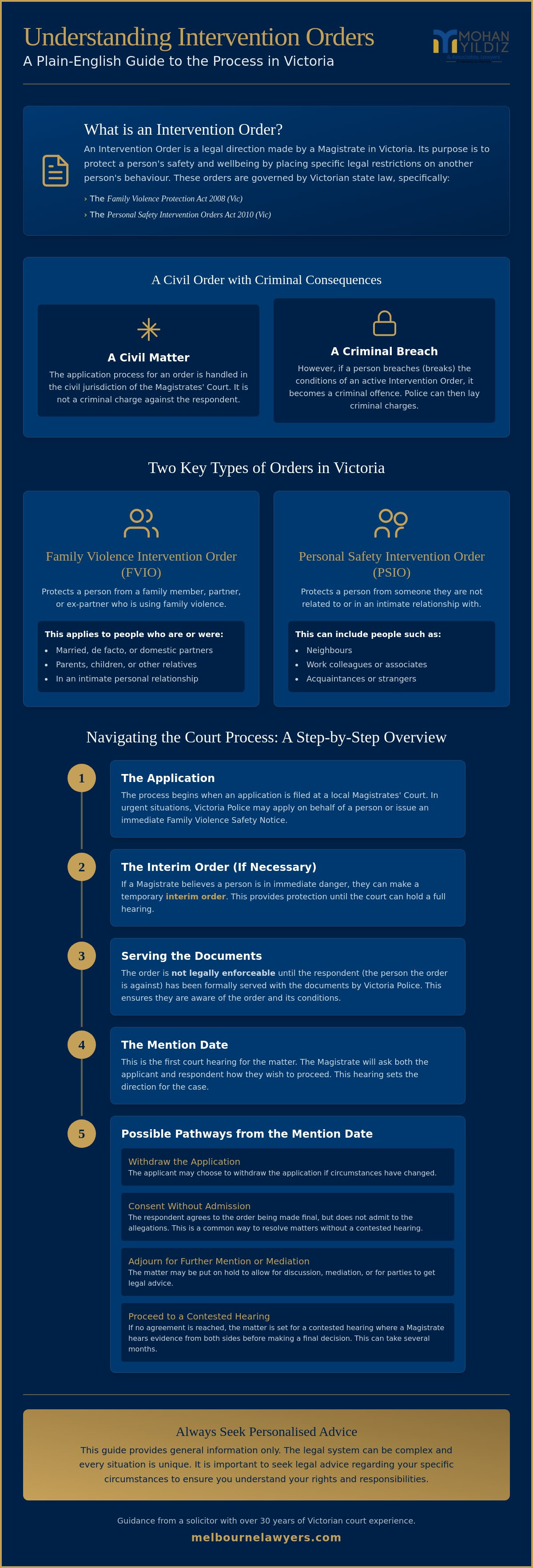
An intervention order is a legal direction made by a Magistrate in the Victorian court system. Its primary purpose is to provide safety and peace of mind by protecting a person from harm, harassment, or fear. In Victoria, the system is specifically structured to address different types of relationships and risks.
These orders work by placing specific restrictions on the behaviour of the person they are made against. This might include staying a certain distance away from your home or workplace, or refraining from making contact. It's helpful to understand that while an intervention order is a civil matter, it carries significant weight. If the conditions are breached, it becomes a criminal matter, and police can take immediate action. This distinction ensures the system prioritises protection while providing clear consequences for non-compliance.
Family Violence vs Personal Safety Orders
In Victoria, the law distinguishes between two main types of orders based on the relationship between the parties involved. A Family Violence Intervention Order (FVIO) is made under the Family Violence Protection Act 2008 (Vic) and applies to family members or domestic partners. Conversely, a Personal Safety Intervention Order (PSIO) is made under the Personal Safety Intervention Orders Act 2010 (Vic) and applies to neighbours, colleagues, or acquaintances. Both applications are handled through the Victorian Magistrates' Court to ensure a foundation of safety.
Taking the first step toward an order can feel overwhelming. With over 30 years of experience in Victorian courts, we understand the importance of providing plain-English guidance during these stressful times. Because every situation is unique, you should seek legal advice regarding your specific situation as early as possible.
The Process of Applying for or Responding to an Order
Applying for or responding to an intervention order is a structured legal process designed to bring clarity to difficult situations. Whether you're seeking protection or have been served with papers, the journey usually begins at a local Magistrates' Court of Victoria. In urgent cases, Victoria Police may apply on your behalf or issue a Safety Notice immediately. For standard applications submitted by email, a registrar will contact you to process the paperwork and set a court date.
Once an application is filed, the court sets a "mention date". This is the first time the matter is heard in court. It's vital to remember that an order isn't active or legally enforceable until the respondent has been formally served with the documents by the police. This ensures everyone involved understands their rights and responsibilities from the outset. If you feel overwhelmed by the requirements of the court, speaking with a member of our team can help provide the reassurance you need.
The Role of the Interim Order
If the court believes someone is in immediate danger, a Magistrate can make an interim order during the very first application. This provides temporary protection while the court waits for a final hearing to take place. These orders often include conditions like staying a certain distance from a home or school, or a "no-contact" clause. It isn't a final decision on the facts, but a necessary safety measure to maintain a foundation of security for all parties involved.
Attending the Magistrates’ Court
On the mention date, the Magistrate will ask how the parties wish to proceed. There are several paths available. The applicant might choose to withdraw the application if circumstances have changed. Alternatively, the respondent may "consent without admission" to the order. This means they agree to the conditions without admitting to any of the allegations. If an agreement cannot be reached through a non-adversarial approach, the matter may move toward a contested hearing at a later date. Having a solicitor with over 30 years of Victorian court experience by your side ensures you have a steady, calm guide through these options.
You should always seek legal advice regarding your specific situation.
Navigating Rights and Responsibilities Calmly
Approaching legal proceedings with a calm mind is essential for achieving a sustainable resolution. Whether you're the applicant or the respondent, an intervention order should be viewed as a tool for safety and clarity rather than a weapon of conflict. It's often the case that a non-adversarial approach leads to better long-term outcomes, especially when complex family dynamics are involved. Reviewing the specific conditions of an order requires meticulous attention to detail. Small misunderstandings about what is or isn't allowed can lead to unintended breaches, so it's vital to understand your responsibilities fully from the moment an order is served.
For those responding to an application, the process can feel isolating. However, the Victorian legal system provides pathways to resolve disputes with dignity. Acknowledging the boundaries set by the court is often the first step toward a peaceful future. Our role is to act as a steady advocate, ensuring you understand every condition while prioritising the long-term wellbeing of everyone involved.
Mediation and Dispute Resolution
In many Victorian cases, parties may find that a formal court order isn't the only path forward. Mediation and dispute resolution services can help both sides communicate through a neutral third party to address the root causes of tension. One common alternative is an "Undertaking". This is a formal promise made to the court to behave in a certain way or follow specific rules. While an Undertaking isn't a court order, breaking it can lead to the original application being brought back before a Magistrate. This often provides a way to resolve the matter with minimal further stress for the family.
Impact on Family Law and Parenting
When children are involved, the situation becomes more complex. It's a common misconception that an intervention order automatically overrides existing parenting orders. In reality, the two must be carefully balanced to ensure the safety of the protected person while maintaining the best interests of the children. If you find yourself in this position, seeking family law advice is a critical step. This ensures that any arrangements for changeovers or communication are legally sound and don't put anyone at risk of a breach.
Every situation is unique, and you should seek legal advice regarding your specific situation.
Seeking Practical Support and Legal Guidance
Managing the complexities of an intervention order is rarely something you should do alone. During such a highly emotional time, a solicitor provides more than just legal knowledge; they offer a steady hand and clear communication. Having a representative who has worked within the Victorian court system for over 30 years brings a level of reassurance that's difficult to find elsewhere. It allows you to focus on your personal wellbeing while your legal matters are handled with meticulous care and integrity.
Professional representation ensures that your side of the story is presented clearly and in strict accordance with Victorian law. We believe that transparency is the foundation of a good relationship, which is why we prioritise plain-English advice and a clear fee structure. This approach removes the guesswork from the legal process, letting you understand exactly where you stand at every step. By moving away from confusing legalese, we help reduce the anxiety often associated with the Magistrates' Court.
The Benefit of Experienced Advocacy
A solicitor can act as a bridge between parties, negotiating on your behalf to reach a fair and safe conclusion without escalating tensions. This non-adversarial focus is particularly important in family law matters where long-term relationships may still need to function in some capacity. Your peace of mind and safety are the primary goals. Having a dedicated advocate means your interests are protected through every mention and hearing, allowing for a resolution that looks toward a calmer future.
If you have questions about how these laws apply to you, we encourage you to contact a legal professional to discuss your specific situation.
Every situation is unique, and you should seek legal advice regarding your specific situation.
Reclaiming Your Peace of Mind and Safety
Securing an intervention order is a practical step towards a safer and more stable future for you and your family. Throughout this guide, we've explored how the Victorian court system provides protection while prioritising the wellbeing of all parties involved. Navigating these matters is most effective when you focus on clear communication and non-adversarial outcomes. Our team brings over 30 years of experience in Victorian courts to provide the steady advocacy you need during this time. We focus on providing plain English advice without hidden legal jargon, supported by fixed and transparent fee options to give you financial certainty and peace of mind.
You don't have to face the legal process alone. A calmer, more secure path is possible when you have a dedicated partner by your side. Every situation is unique, and you should seek legal advice regarding your specific situation.
Frequently Asked Questions
What is the difference between a family violence and a personal safety order?
Family Violence Intervention Orders (FVIOs) protect people from family members, including current or former partners and relatives. Personal Safety Intervention Orders (PSIOs) are used for situations involving people who aren't family, such as neighbours, colleagues, or acquaintances. Both applications are heard at the Magistrates' Court of Victoria. The main difference lies in the relationship between the parties, though both aim to provide a foundation of safety for the applicant.
Can an intervention order be changed or cancelled after it is made?
Yes, an intervention order can be varied or revoked by making an application to the court. Either the protected person or the respondent can apply to change the conditions or cancel the order entirely. A Magistrate will then hold a hearing to decide if the requested changes are appropriate. It's essential to have clear reasons for the request, as the court's primary concern remains the ongoing safety of the protected person.
What happens if someone breaches an intervention order in Victoria?
Breaching an order is a serious matter that moves the situation from a civil dispute to a criminal one. If the conditions are not followed, Victoria Police have the power to arrest and charge the person responsible. A breach can lead to a criminal record, which may have long-term consequences for employment and travel. Following every condition meticulously is the best way to avoid these legal complications and maintain a clear record.
How does an intervention order affect my ability to see my children?
An intervention order does not automatically end your right to see your children, but it does require careful management. The court prioritises the safety of children and the protected person above all else. If you have existing parenting orders, the intervention order conditions should be drafted to allow for changeovers and communication where it is safe to do so. Aligning these two areas of law requires a calm and non-adversarial approach.
Do I have to go to court if I agree with the intervention order?
You typically need to attend the first court date, known as the mention, even if you agree with the order. Attending allows you to "consent without admission," which means you agree to the conditions without admitting to the allegations made against you. This approach can resolve the matter quickly without the need for a contested hearing. It ensures the process remains straightforward and minimises further conflict for everyone involved.
Every situation is unique, and you should seek legal advice regarding your specific situation.
Disclaimer
This article is general information only and is not legal advice. Laws change, and every situation is different. Contact Mohan Yildiz & Associates for advice about your circumstances.